Please support democracy

Without your support, Democracy Watch can't win key changes to stop governments and big businesses from abusing their power and hurting you and your family. Please click here to support democracy now

Green Party receives B grade – best of overall bad grades in Report Card on Federal Parties’ 2025 Democratic Reform Platforms

Bloc, Conservatives and NDP tie with C- while Liberals get a D- and PPC an F

Great to see Green Party again promise to enact a partial honesty-in-politics law but, given lack of law and past pattern of ruling party breaking half of democratic reform promises, voters should be very skeptical of every promise made by every party

Party leaders should agree to 8 key, written rules to have a fair post-election, and fair government, especially if it is a minority government

FOR IMMEDIATE RELEASE:
Friday, April 25, 2025

OTTAWA – Today, Democracy Watch released its Report Card on the Federal Parties’ 2025 Democratic Reform Platforms which evaluates their platforms in five key areas of democratic good government (See the Report Card below and click here to see the grading system and criteria).

Many surveys over the past 15 years have shown that a large majority of voters do not trust politicians, and want strong honesty, ethics, lobbying, political finance, open government and other democracy and accountability reforms to stop politicians from abusing their power.  Hundreds of thousands of messages have been sent to federal party leaders and politicians through Democracy Watch’s campaigns calling for the dozens of key changes needed to ensure fully democratic and accountable federal government and politics.

The Green Party received a B as the best grade of overall bad grades for all the parties, which ties the best grade any party has ever received going back to 1993.  The Bloc, Conservatives and NDP all tied with C- while the Liberals received a D- and the PPC an F.

However, given the current lack of an honesty-in-politics law, and the fact that Prime Minister Chrétien, Prime Minister Harper, and Prime Minister Trudeau all failed to keep half of their democratic reform promises (Prime Minister Martin didn’t make any), voters should be very skeptical of every promise made by every party.

“While it is notable that the Green Party has promised a partial honesty-in-politics law covering only false claims made in election advertising, given the current lack of such a law, voters should be wary of trusting any political promises,” said Duff Conacher, Co-founder of Democracy Watch.

The Green Party’s platform is fairly detailed and comprehensive in four of the five areas evaluated, with their lowest grade in the area of Efficient Government as they proposed fewer and mostly vague government spending accountability measures.  Unfortunately, the Greens also propose (on p. 89 of their platform) exploring the implementation of online voting which is very dangerous because the vote count can’t be verified, and the implementation of mandatory voting which would violate the Charter unless a right to vote “none of the above” is also enacted.

The Mark Carney Liberals’ D- grade platform is a failure compared to their 2015 election platform that received a B grade, and is as weak as the Liberals’ (un)democratic reform record since 2015, which has included: Prime Minister Trudeau breaking his electoral reform promise; the Liberals breaking most of their open government promises and ignoring recommendations to stop secret, fake online election ads in a unanimous House Committee report; Trudeau and Liberal Cabinet ministers being involved in many secrecy and ethics scandals (including the SNC-Lavalin scandal) and covering up foreign interference and delaying an inquiry and laws to address it; and, most recently, Trudeau proroguing Parliament; Mark Carney calling a snap election before key anti-foreign interference and whistleblower protection measures were enacted and hiding his investments that cause financial conflicts of interest.

Mark Carney has shown clear signs of having a ‘father knows best’ attitude that favours secrecy over transparency and is dismissive of unethical conflicts of interest, and the Liberals’ negligently weak democratic reform and government accountability election platform is a worrying signal that he wants power with few restrictions and little accountability,” said Conacher.

The Conservatives C- grade platform was very weak compared to their 2006 election platform when they were elected into power – in that platform the Conservatives promised 60 comprehensive democratic reform and government accountability changes in their so-called “Federal Accountability Act”, and earned them a B grade.

“The Conservative platform pales in comparison to their 2006 Federal Accountability Act platform that promised 60 comprehensive democratic and accountability reforms, as their “Accountability Act 2.0” promises would only make 10 changes, nine strengthening ethics rules and one partially increasing lobbying disclosure,” said Conacher. “It is worrying also that the Conservative platform doesn’t even mention or propose any measures to stop disinformation given that it threatens democracy and is a main means of foreign interference in Canadian politics.”

Conservative leader Pierre Poilievre’s pledge to use the notwithstanding clause is also very concerning — DWatch recently joined with more than 25 other organizations in calling on all party leaders to commit to a public consultation on restricting the use of the clause.

The NDP’s C- grade platform is also very weak compared to their 2015 election platform when they earned a B grade.

“Given a large majority of voters want comprehensive democratic reforms, it is unfortunate for the NDP that they continue to forget their middle name when making election promises,” said Conacher.

“While all the federal parties, especially the Greens, have some key democracy reforms and promise some important general accountability reforms in their platforms, they all unfortunately continue to fail to promise to close key loopholes and correct key flaws in federal laws, and to ignore high voter concern about democracy and trust issues,” said Conacher.  “Canadians can only hope that the parties will actually address these concerns when Parliament opens again so that everyone in federal politics will, finally after 158 years, be effectively required to act honestly, ethically, openly, representatively and to prevent waste.”

Democracy Watch’s campaigns and coalitions will keep pushing for the dozens of key changes needed to ensure everyone in federal politics is effectively required to be honest, ethical and transparent, and to make representative decisions and to prevent waste.

– 30 –

FOR MORE INFORMATION, CONTACT:
Duff Conacher, Co-founder of Democracy Watch
Tel: (613) 241-5179
Cell: 416-546-3443
Email: [email protected]

Democracy Watch’s Campaigns page


Democracy Watch
Report Card on the Federal Parties’
2025 Democratic Reform Platforms
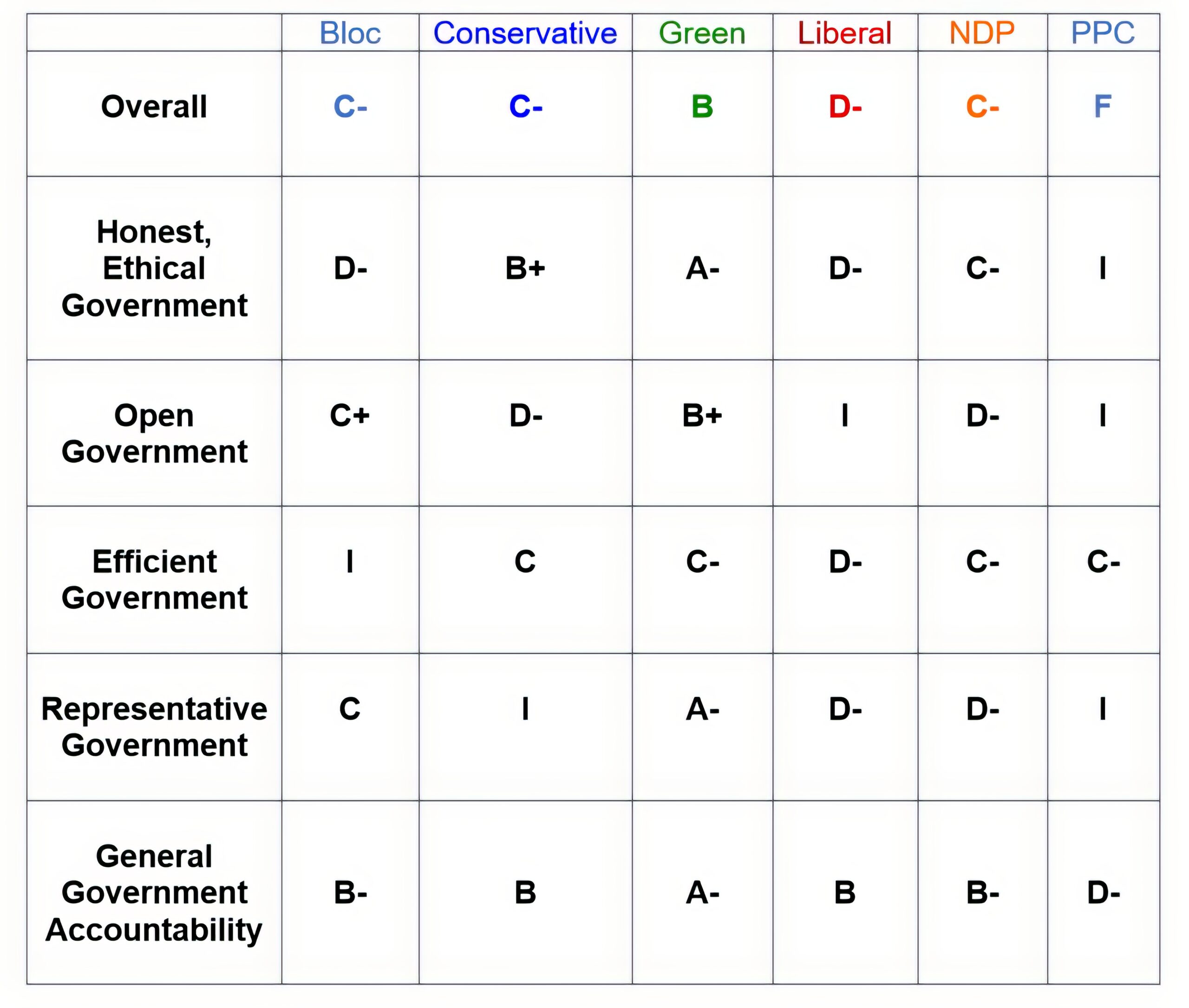


Sources:

Click here to see the grading system and criteria used to assess the parties’ platforms.


Bloc Québécois platform webpage (PDF)

NOTE: See p. 19 re: Representative Government promises to establish a discrimination ombudsman, eliminate mention of the monarchy from the citizenship oath and the public office oath; p. 24 for promises re: anti-foreign interference, public funding for political parties, strengthening Ethics Commissioner, reforming the Access to Information Act and tightening the lobbyists registry.

For General Government Accountability promises see: p. 9 re: consumer protection; p. 14 re: various, including transnational repression and corporate responsibility measures; p. 23 re: closing tax haven and tax evasion loopholes; p. 24 re: merit-based government applications, strengthening Export Development Canada (EDC) accountability, strengthening the Privacy Act, requiring public inquiry commissioners to be appointed by Parliament (instead of by the ruling party Cabinet), and strengthening whistleblower protection; p. 25 re: strengthening criminal law enforcement and justice reforms, and; p. 28-31 re: environmental protection


Conservative Party of Canada platform webpage

NOTE: See pages 13-14 of platform PDF for Honest, Ethical Government and Open Government promises strengthening conflict of interest rules, disclosure rules, enforcement and penalties; p. 16 re: requiring third parties to disclose funding sources, strengthening anti-money laundering, anti-financial crime and anti-foreign interference enforcement, and expelling foreign agents;

For Efficient Government promises p. 13 re: one-for-one spending law reducing spending or increasing revenues to offset any new spending, only replace 2 of every 3 public employees who leave the federal government, ban federal government employees from also having government contracts, and cut $10.5 billion in spending on consultants;
For General Government Accountability promises, see: p. 5 re: Taxpayer Protection Act to prohibit raising taxes without a referendum; closing tax loopholes; p. 8 re: an oligopoly review and banning write-offs for luxury private jets; p. 10 re: increasing accountability for municipalities building houses; p. 11 re: strengthening criminal law enforcement, including in the area of online harassment; p. 12 re: anti-racketeering, anti-money laundering and anti-forced and child labour laws and other criminal law reforms; p. 13 re: closing offshore tax loopholes and strengthening enforcement, and using plain language laws; p. 15 re: strengthened border enforcement; p. 16 re: Farmland Protection Act to prevent foreign ownership; p. 17 re: requiring union LMIA pre-checks, criminal background checks for foreign students and quicker removal of people on visitor visas who commit crimes; p. 19 re: launch a $44 billion lawsuit against Big Pharma to pay for addiction treatment and recovery; p. 20 re: respecting union rights, and; p. 21 re: Stop Scamming Seniors Act to force banks and telecom companies to help stop fraud scams.


Green Party of Canada platform webpage

NOTE: For Honest, Ethical Government promises, see in platform PDF: p. 40 and p. 86 re: strengthening anti-foreign interference and anti-disinformation measures, including truth in political advertising rules; p. 90 re: lowering the donation limit, strengthening third-party finance rules, implementing a per-vote subsidy, establishing a foreign-agent registry, strengthening anti-foreign interference enforcement, empowering the Commissioner of Canada Elections to penalize false political advertising, requiring more transparency in reporting of survey results and increasing accountability; p. 91 re: strengthening ethics rules, closing the revolving door of people leaving government and becoming lobbyists, strengthening the independence and investigative powers of the Ethics Commissioner and Commissioner of Lobbying; p. 116 re: regulate social media and digital platforms to make them more transparent and accountable for all content published, including libel, slander, disinformation and election interference, and strengthen digital rights protections.

For Open Government promises, see: pp. 91-92 re: increasing lobbying disclosure requirements, strengthening the independence and investigative powers of the Information Commissioner (including reviewing Cabinet confidentiality claims), ensuring proactive disclosure of government documents and timely responses to access to information requests, applying the law to minister’s offices, scrapping most access fees, overriding secrecy exemptions in the public interest.
For Representative Government promises, see: p. 81 re: lowering the voting age to 16; pp. 89-90 re: implementing a proportional representation voting system through a Citizen Assembly process and requiring parties to report on candidate recruitment from underrepresented groups; p. 90 re: restrict the use of the notwithstanding clause; pp. 99-100 respect Quebec’s power over areas of provincial and shared jurisdiction; p. 110 re: prohibit advocating or assisting in the annexation of Canada by a foreign power; p. 114 re: restrict foreign ownership and control of media.
For Efficient Government promises, see: p. 21 re: ensure transparent and fair procurement processes; p. 91 re: strengthening the independence and investigative powers of the Auditor General and Parliamentary Budget Officer, and replacing the House Board of Internal Economy with an independent committee to oversee MP spending, enhance oversight and accountability to prevent misuse of taxpayer dollars, reduce wasteful spending at the by politicians including reducing the Prime Minister’s Office budget from $10 million to $1 million.
For General Government Accountability promises see: pp. 5-7 re: increasing corporate and wealth taxes and close tax haven and tax evasion loopholes; p. 7 end corporate subsidies that don’t provide benefits and support international pollution tax and financial services tax; pp. 8-9 strengthen worker rights; pp. 12-13 re: protect critical resources and industries from foreign takeover and increase accountability of foreign companies in Canada; p. 14 re: ensure fair trade; pp. 15-17 protect natural resources; p. 22 ensure transparency and accountability in CPP investments; pp. 33-34 protect agriculture industry and farm worker rights; pp. 42-43 re: strengthen border protection and ensure military spending and actions are ethical; pp. 47-54 re: environmental protection measures; p. 58 re: protections for housing affordability, including to stop financial speculation in housing; p. 68 re: banning toxic chemicals; p. 69 re: long term care accountability measures; p. 72 re: disability rights protections; p. 76 re: protections for veterans; p. 78 re: ethical and fair international student recruitment measures; p. 81 re: protections for youth using social media; pp. 84-85 re: protections for gender and women’s rights; p. 91 re: strengthening whistleblower protection; p. 92 re: expanding privacy protections; pp. 95-98 re: implement the recommendations of the Truth and Reconciliation Commission and the Inquiry into Missing and Murdered Indigenous Women and Girls, and increase Indigenous rights and sovereignty generally; p. 105 re: strengthen the accountability of the immigration system and protections for temporary foreign workers; pp. 108-109 re: strengthen the effectiveness of criminal law justice processes, especially for Indigenous and racialized offenders, and ensure jails are humane; p. 118 restrict and regulate Artificial Intelligence in the areas of ethical use, transparency, accountability, environmental impacts and data privacy; pp. 120-121 re: strengthen consumer protections in various business sectors.


Liberal Party of Canada platform webpage

For Honesty and Government Ethics promises, see: p. 6 re: empowering CBC/Radio Canada  to combat disinformation; p. 9 re: addressing the recommendations to combat military sexual misconduct;
For Representative Government promises, see: pp. 5-6 re: changing CBC/Radio Canada’s governance plan to improve accountability and citizen engagement, and strengthening local news and the inclusion of Indigenous perspectives; pp. 8 and 17 re: vague promises to be “vigilant against foreign interference” and boost resources to fight foreign interference and transnational repression;
For Efficient Government promises, see: pp. 57-58 re: increase federal government spending efficiency and productivity;
For General Government Accountability promises, see in platform PDF: p. 4 re: making housing more accessible; p. 7 re: increasing transparency to help Canadians buy Canadian; p. 12 re: increasing support for veterans; p. 13 re: strengthening the Investment Canada Act to prevent foreign takeovers of key industries and the public health care system; p. 16 re: protecting marine life; pp. 16-17 re: strengthening gun control and border protection; pp. 18-19 re: strengthening criminal law enforcement, including of anti-hate laws; pp. 27-28 re: protecting the environment; pp. 31-33 re: enhance Charter rights and anti-discrimination protections, including by expanding the Court Challenges Program; p. 34 re: implement the recommendations of the Truth and Reconciliation Commission, the Inquiry into Missing and Murdered Indigenous Women and Girls, and implement the United Nations Declaration on the Rights of Indigenous Peoples Act and Action Plan; p. 35 pass legislation affirming First Nations’ right to clean drinking water; p. 38 re: make mortgages more affordable and make big polluters pay; p. 42 re: reinforcing the immigration system’s integrity and border integrity; pp. 46-47 measures to make big polluters pay and require companies to disclose climate risks; p. 52 re: strengthen the social safety net; p. 55 re: make the tax system fairer and to close loopholes and strengthen enforcement; pp. 64-65 committing to continuing to screen government commitments and actions using the Gender-Based Analysis tool.


NDP platform webpage (no PDF available)

NOTE: See in “Strengthening Canada’s democracy” section promises re: establishing a Citizen Assembly to advise on implementing a mixed member proportional voting system, lowering the voting age to 16-17, make voting more accessible by putting Indigenous languages on ballots, implementing a three-day voting period and strengthening voting on campuses, restoring federal government Ministries for women and gender equality and for people with disabilities and for diversity, implementing a comprehensive approach to combat transnational repression, implement the recommendations of the Hogue Commission on foreign interference, enact anti-disinformation and misinformation measures, and implement the foreign agent registry.

In Revenue Measures section see Efficient Government promises re: reducing the number of expensive external contractors, increasing transparency and accountability in the federal government budget-making process, and linking spending to policy outcomes.
For General Government Accountability promises, see: sections on public health care, rent control and tenant protection, cap on grocery prices, taxing extreme wealth, protecting essential industries, making big polluters pay, passing an Environmental Bill of Rights and establishing an Office of Environmental Justice and passing a biodiversity accountability law, upholding Indigenous rights and implementing the Truth and Reconciliation Commission recommendations  and equalizing funding for social welfare for Indigenous children, a surtax on the most profitable corporations, close tax haven loopholes.


People’s Party of Canada platform webpage

NOTE: See pages 14-15 of platform PDF re: Efficient Government promises.

For General Government Accountability promises, see: p. 18 re: combatting money laundering; p. 23 re: eliminating corporate subsidies, and; p. 23 re: veterans’ rights.

Survey finds 84% of voters think it’s unethical for lobbyists to fundraise and campaign for politicians

87% think it’s important for voters to know who has lobbied which politicians before deciding how to vote and whether to support policies

Secret, unethical lobbying is legal because the federal Commissioner of Lobbying and all MPs have gutted ethics rules, failed to close loopholes

DWatch calls on all parties to disclose, before election day, everyone who has fundraised, campaigned or assisted them significantly in the past year

FOR IMMEDIATE RELEASE:
Wednesday, April 16, 2025

OTTAWA – Today, Democracy Watch released the national survey it commissioned from Nanos Research that shows more than 80% of Canadians are concerned about the corrupting effects of secret, unethical lobbying on politicians’ policy-making decisions, and want to know about all lobbying activities.  Nanos did the hybrid telephone and online random survey of 1,077 Canadians, 18 years of age or older, between January 31 and February 3, 2025, as part of an omnibus survey. The margin of error for the survey is ±3.0 percentage points, 19 times out of 20.

Democracy Watch has contacted all federal parties calling on them to, before election day, disclose everyone who has fundraised or campaigned or assisted them in any significant way in the past year, including during the Liberal Party leadership contest, as voters have a right to know before they vote who each party owes, especially if they owe any lobbyists or people who work at lobbying firms or businesses or organizations who lobby the federal government.

Secret, unethical lobbying is legal in federal politics because of a “dirty dozen” huge secret lobbying loopholes in the federal lobbying law that all federal parties have failed to close, and because the Commissioner of Lobbying and MPs from all parties gutted key ethical lobbying rules in the Lobbyists’ Code of Conduct in 2023 even though 26 citizen groups with a total membership of more than one million Canadians, and more than 20,000 voters, and dozens of law, politics and ethics professors and lawyers opposed gutting the rules.

The “dirty dozen” secret lobbying loopholes make it easy to lobby in secret, especially for big business lobbyists. The unethical lobbying loopholes allow lobbyists to secretly campaign for and/or secretly assist a politician or party in significant ways and lobby them at the same time, and to secretly fundraise an unlimited amount of money for a politician or party and/or secretly campaign for them full-time, and then lobby them within 1 to 2 years afterwards. The Commissioner of Lobbying can also secretly reduce that “cooling-off” time period, and also give secret exemptions that allow lobbyists to give expensive gifts and meals to politicians and government officials.

The survey results (PDF) show that 84-87% of Canadians surveyed said they think:

(i) that a politician who receives undisclosed assistance (fundraising, campaigning, event organizing etc.) from a lobbyist is less likely or somewhat less likely to act in the public interest;

(ii) that they are uncomfortable or somewhat uncomfortable with a lobbyist lobbying a politician within 1 to 2 years after assisting the politician;

(iii) that it is important to know who has lobbied a politician, and how much they have been lobbied, when deciding which government policies to support and who to vote for, and;

(iv) that it is important to know whether a lobbyist has been given an exemption by the Commissioner of Lobbying to the rules that limit the value of gifts given to politicians, and that prohibit a lobbyist from lobbying for 1 to 2 years after assisting a politician.

As well, about 69% of people surveyed said they think that a politician who receives undisclosed gifts worth only up to $200 a year from a lobbyist is less likely or somewhat less likely to act in the public interest.

“A large majority of voters are understandably concerned about lobbyists secretly fundraising, campaigning and doing favours for politicians and political parties, and then asking them to return the favours soon afterwards,” said Duff Conacher, Co-founder of Democracy Watch.  “All the federal parties should disclose before election day the list of everyone who has fundraised or campaigned or assisted them in any significant way in the past year, including during the Liberal Party leadership contest, as voters have a right to know before they vote who has bankrolled and done other favours for each party, and who each party owes.”

“It’s outrageous that MPs from all parties have left open loopholes in the federal lobbying law that allow for secret lobbying, and that they all worked with the Commissioner of Lobbying to create new loopholes to allow lobbyists to essentially secretly bribe them with fundraising, working on campaigns and other favours,” said Conacher.  “Until all of these loopholes are closed, secret corrupt favour-trading between lobbyists and politicians will continue to be legal and will undermine every federal policy-making and government contracting process.”

– 30 –

FOR MORE INFORMATION, CONTACT:
Duff Conacher, Co-founder of Democracy Watch
Tel: (613) 241-5179
Cell: 416-546-3443
Email: [email protected]

Democracy Watch’s Stop Secret, Unethical Lobbying Campaign and Government Ethics Campaign and Money in Politics Campaign


Group asks Ontario AG to have independent special prosecutor review evidence for prosecution of Trudeau for SNC-Lavalin scandal

Application in Ottawa provincial court calls for impartial process and open court hearing to consider evidence of obstruction of justice and breach of trust

RCMP did weak investigation, made a secret, behind-closed doors, very questionable decision not to prosecute, and hid investigation records and is still hiding key evidence – independent anti-corruption police force needed

FOR IMMEDIATE RELEASE:
Friday, March 21, 2025

OTTAWA – Today, Democracy Watch released the letter it has sent to Ontario’s Attorney General Doug Downey calling on him to have an independently appointed special prosecutor review the evidence and DWatch’s application in the Ontario Court of Justice in Ottawa for approval from the court to proceed with a private prosecution of former Prime Minister Justin Trudeau for pressuring, and directing others to pressure, then-Attorney General Jody Wilson-Raybould to stop the prosecution of SNC-Lavalin in 2018 (now operating under the name “AtkinsRéalis”).

Wayne Crookes, founder of Integrity B.C., is a key supporter of the application.  Jen Danch of Swadron Associates law firm, is representing Democracy Watch for the application.

The application includes a legal opinion by a retired superior court justice (who did the opinion on the condition of remaining anonymous) supporting prosecuting the PM for the allegation of obstruction of justice, and possibly also for breach of trust.  The application also includes a “will say” document that summarizes the reasons for the application, and a summary of how the RCMP failed to investigate and uphold the law properly.

As detailed in Democracy Watch’s recent news release, the RCMP’s investigation was weak, incomplete, delayed and buried for years, and amounts to an attempted cover up.  The RCMP only interviewed four of 15 key witnesses, and is hiding key testimony from Wilson-Raybould, her Chief of Staff Jessica Prince, and her friend and confidante Jane Philpott.  The RCMP also accepted the Trudeau Cabinet hiding key internal communication records, and trusted without question the biased, self-interested public statements of the PM and everyone else who pressured the AG.

In addition, and importantly, as Democracy Watch’s “will say” document details, the RCMP applied an improper legal standard for proving obstruction of justice, and didn’t even consider prosecuting anyone for the general violation of breach of trust.

“The RCMP did a very superficial investigation into the Trudeau Cabinet’s obstruction of the prosecution of SNC-Lavalin, didn’t even interview many witnesses or try to obtain key secret Cabinet communication records, and buried the investigation with an almost two-year delay, and then made a behind-closed-doors, very questionable decision not to prosecute anyone,” said Duff Conacher, Co-founder of Democracy Watch. “Democracy Watch’s position is that the evidence and testimony of all witnesses should be considered by a judge in an open court hearing, and that is why it is applying for court approval to proceed with a private prosecution.”

Ontario’s Attorney General has the power to have a Crown prosecutor step in and take over the prosecution, and then stop it from proceeding.  The next steps in the private prosecution process are a “speak to” hearing on Friday, March 28th in Ottawa where a judge will consider procedural issues including scheduling a “pre-enquête” hearing where Democracy Watch would present its evidence and arguments for allowing the prosecution to proceed.

Democracy Watch’s letter today calls on Ontario’s Attorney General, working with opposition party leaders, to establish a committee made up of people who have no ties to any political party.  The committee will choose a lawyer who has no ties to any party to be an Independent Special Prosecutor who will review the evidence and issue a public decision concerning prosecuting Trudeau.  That process is needed to ensure an impartial review and decision concerning whether the Attorney General will have a Crown prosecutor step in, take over and/or stop the prosecution.

“The RCMP lacks independence from the Prime Minister and Cabinet ministers who handpick the RCMP Commissioner and deputy commissioners and division heads through a secretive process, and they all serve at the pleasure of the Cabinet so they are vulnerable to political interference, which is likely part of the reason the RCMP rolled over and let Trudeau off,” said Conacher.  “The Attorney General is also a tainted by partisanship as he is from Ontario’s ruling party and so, to ensure integrity and impartiality, a fully independent special prosecutor needs to be appointed to review the evidence concerning whether the prosecution of Trudeau should proceed.”

“A public inquiry is needed to determine why the RCMP’s national command tried to cover up its investigation, and exactly how and why they and Crown prosecutors decided not to prosecute anyone,” said Conacher. “The RCMP consistently fails to enforce Canada’s anti-corruption laws in a timely, effective way, which shows the need for key changes that many experts have called for to make the RCMP more independent, effective and publicly accountable, especially when it is investigating corruption cases, or even better to establish a new fully independent anti-corruption police force including fully independent prosecutors.”

– 30 –

FOR MORE INFORMATION, CONTACT:
Duff Conacher, Co-founder of Democracy Watch
Tel: (613) 241-5179
Cell: 416-546-3443
Email: [email protected]

Democracy Watch’s Government Ethics Campaign, Stop Unfair Law Enforcement Campaign and Open Government Campaign

La Cour provinciale d’Ottawa demande une procédure impartiale et une audience publique pour examiner les preuves d’obstruction à la justice et d’abus de confiance

La GRC a mené une enquête médiocre, a pris en secret, derrière des portes closes, une décision très discutable de ne pas engager de poursuites, a caché des dossiers d’enquête et cache toujours des preuves essentielles – une force de police anticorruption indépendante est nécessaire

POUR PUBLICATION IMMÉDIATE:
Vendredi 21 mars 2025

Pour diffusion immédiate:
Vendredi 21 mars 2025

OTTAWA – Aujourd’hui, Democracy Watch a publié la lettre qu’elle a envoyée au procureur général de l’Ontario Doug Downey lui demandant de faire en sorte qu’un procureur spécial nommé de manière indépendante examine les preuves et le rapport de DWatchdemande à la Cour de justice de l’Ontario à Ottawa pour obtenir l’approbation de la cour afin de procéder à une poursuite privée de l’ancien Premier ministre Justin Trudeau pour avoir fait pression, et ordonné à d’autres de faire pression sur Jody Wilson-Raybould, alors procureur général, pour qu’elle arrête les poursuites contre SNC-Lavalin en 2018 (qui opère maintenant sous le nom d'”AtkinsRéalis”).

Wayne Crookes, fondateur d’Integrity B.C., est l’un des principaux défenseurs de la demande. Jen Danch, du Swadron Associates law firm, représente Democracy Watch pour la requête.

avis juridique d’un juge de la Cour supérieure à la retraite (qui a émis l’avis à la condition de rester anonyme) soutenant la poursuite du Premier ministre pour l’allégation d’obstruction à la justice, et peut-être aussi pour abus de confiance. La demande comprend également un document “will say” document qui résume les raisons de la demande, et un résumé de la façon dont la GRC a échoué à enquêter et à faire respecter la loi correctement.

recent news release), l’enquête de la GRC a été faible, incomplète, retardée et enterrée pendant des années, ce qui équivaut à une tentative d’étouffement de l’affaire. La GRC n’a interrogé que quatre des 15 témoins clés et cache des témoignages essentiels de Mme Wilson-Raybould, de sa chef de cabinet Jessica Prince et de son amie et confidente Jane Philpott. La GRC a également accepté que le Cabinet Trudeau cache des documents de communication interne essentiels, et a fait confiance sans discussion aux déclarations publiques biaisées et intéressées du Premier ministre et de tous ceux qui ont exercé des pressions sur le procureur général.

“will say” document, la GRC a appliqué une norme juridique inappropriée pour prouver l’obstruction à la justice, et n’a même pas envisagé de poursuivre qui que ce soit pour la violation générale de l’abus de confiance.

“La GRC a mené une enquête très superficielle sur l’obstruction du Cabinet Trudeau à la poursuite de SNC-Lavalin, n’a même pas interrogé de nombreux témoins ou essayé d’obtenir des documents secrets de communication du Cabinet, et a enterré l’enquête avec un retard de près de deux ans, puis a pris une décision à huis clos, très discutable, de ne poursuivre personne”, a déclaré Duff Conacher, cofondateur de Democracy Watch.d’intervenir et de prendre en charge la poursuite, puis de l’empêcher d’aller de l’avant. Les prochaines étapes du processus de poursuite privée sont une audience “speak to” le vendredi 28 mars à Ottawa où un juge examinera les questions de procédure, y compris la programmation d’une audience “pre-enquête” où Democracy Watch présenterait ses preuves et ses arguments pour permettre à la poursuite d’aller de l’avant.

La procédure de poursuite privée est en cours.

La lettre d’aujourd’hui de Democracy Watch demande au procureur général de l’Ontario, en collaboration avec les chefs des partis d’opposition, de mettre en place un comité composé de personnes n’ayant aucun lien avec un parti politique. Le comité choisira un avocat qui n’est lié à aucun parti pour être un procureur spécial indépendant qui examinera les preuves et rendra une décision publique concernant la poursuite de Trudeau. Ce processus est nécessaire pour garantir un examen et une décision impartiaux concernant la question de savoir si le procureur général demandera à un procureur de la Couronne d’intervenir, de prendre le relais et/ou d’arrêter les poursuites.

“La GRC manque d’indépendance par rapport au Premier ministre et aux ministres du Cabinet qui choisissent le commissaire de la GRC, les commissaires adjoints et les chefs de division par le biais d’un processus secret, et ils servent tous selon le bon vouloir du Cabinet, ce qui les rend vulnérables à l’ingérence politique, ce qui explique probablement en partie pourquoi la GRC s’est inclinée et a laissé Trudeau s’en tirer”, a déclaré M. Conacher.

“Une enquête publique est nécessaire pour déterminer pourquoi le commandement national de la GRC a tenté d’étouffer son enquête et comment et pourquoi les procureurs de la Couronne ont décidé de ne poursuivre personne”, a déclaré M. Conacher. “La GRC ne parvient pas à appliquer les lois anti-corruption du Canada de manière opportune et efficace, ce qui montre la nécessité de changements clés que de nombreux experts ont réclamés pour rendre la GRC plus indépendante, efficace et publiquement responsable, en particulier lorsqu’elle enquête sur des affaires de corruption, ou mieux encore pour établir une nouvelle force de police anti-corruption totalement indépendante y compris des procureurs totalement indépendants.”

p style=”text-align : justify”)

– 30 –

POUR PLUS D’INFORMATIONS, CONTACTEZ:
Duff Conacher, Co-fondateur de Democracy Watch
Tel : (613) 241-5179
Cell : 416-546-3443
Email : [email protected]

La campagne de Démocratie en surveillance Gouvernement éthique, Stop Unfair Law Enforcement Campaign et Open Government Campaign

[ :]

Group calls on Liberal leadership contestants to disclose their campaigners, especially lobbyists, before voting ends

Public has right to know, given Lobbyists’ Code was gutted to allow lobbyists to secretly fundraise and campaign for politicians they lobby, and given it is legal for foreigners to secretly help contestants

FOR IMMEDIATE RELEASE:
Tuesday, March 4, 2025

OTTAWA – Today, Democracy Watch emailed a letter to each of the Liberal Party leadership contestants calling on them to disclose the identity of their top campaign managers and staff, top volunteers, and top fundraisers (anyone who has helped organize a fundraising event or appeal, and anyone who has sent out a personal fundraising appeal or held a fundraising event).

Liberal Party members have a right to know before they vote who each contestant owes, and what conflicts of interest have been created by the help provided by each contestant’s campaigners and fundraisers, and the public also has a right to know this information.

Huge loopholes in Canada’s laws allow foreigners, including foreign-government funded front groups and “proxies”, to secretly campaign and fundraise for party leadership contestants.

Commissioner of Lobbying Nancy Bélanger, with the support of the House of Commons Ethics Committee, gutted key ethical lobbying rules in the Lobbyists’ Code of Conduct in 2023, and since then lobbyists have been allowed to do significant campaigning for, and fundraise unlimited amounts of money for, politicians and their parties and lobby them at the same time or soon afterwards.

Still, the campaigning and fundraising lobbyists do for contestants creates a clear conflict of interest, and the federal ethics law prohibits participating in some decisions as Prime Minister when in a conflict of interest (although the law has many huge loopholes).

“Liberal Party members before they vote, and the public generally, have a right to know who each leadership contestant owes, and what conflicts of interest have been created by the people campaigning and fundraising for each contestant,” said Duff Conacher, Co-founder of Democracy Watch. “Given federal ethical lobbying rules have been gutted to allow lobbyists to assist politicians they are lobbying, and given foreign interference in party leadership contests is legal, it is even more important to have public disclosure of who is helping each leadership contestant.”

More than 40 lawyers and professors, many of them leading experts in government ethics, and 26 citizen groups with a total membership of 1.5 million Canadians, and more than 20,000 voters who signed on to Democracy Watch’s petition on Change.org or its letter-writing campaign, have called on federal parties to reverse the gutting of the Lobbyists’ Code so that lobbyists would again be prohibited from assisting politicians and lobbying them at the same time or soon afterwards.

– 30 –

FOR MORE INFORMATION, CONTACT:
Duff Conacher, Co-founder of Democracy Watch
Tel: (613) 241-5179
Cell: 416-546-3443
Email: [email protected]

Democracy Watch’s Stop Secret, Unethical Lobbying Campaign and Government Ethics Campaign and Money in Politics Campaign

Le public a le droit de savoir, étant donné que le code des lobbyistes a été vidé de sa substance pour permettre aux lobbyistes de collecter secrètement des fonds et de faire campagne pour les politiciens qu’ils soutiennent, et étant donné qu’il est légal pour les étrangers d’aider secrètement les candidats

.

POUR UNE DIFFUSION IMMÉDIATE:
Mardi 4 mars 2025

La Commission européenne a publié un rapport sur l’état d’avancement de la mise en œuvre du plan d’action pour l’emploi et le développement durable.

OTTAWA – Aujourd’hui, Democracy Watch a envoyé par courriel une lettre à chacun des candidats à la direction du Parti libéral leur demandant de divulguer l’identité de leurs principaux directeurs de campagne et de leur personnel, de leurs principaux bénévoles et de leurs principaux collecteurs de fonds (toute personne ayant aidé à organiser un événement ou un appel de collecte de fonds, et toute personne ayant envoyé un appel de collecte de fonds personnel ou organisé un événement de collecte de fonds).

D’énormes lacunes dans les lois canadiennes permettent à des étrangers, y compris des groupes de façade et des “mandataires” financés par des gouvernements étrangers, de faire secrètement campagne et de recueillir des fonds pour les candidats à la direction d’un parti.

Les candidats à la direction d’un parti ont le droit de faire campagne et de recueillir des fonds pour les candidats à la direction d’un parti.

a éviscéré les principales règles éthiques du lobbying dans le Code de conduite des lobbyistes en 2023, et depuis lors, les lobbyistes ont été autorisés à faire d’importantes campagnes pour les politiciens et leurs partis, et à recueillir des sommes d’argent illimitées pour eux, et à faire du lobbying auprès d’eux en même temps ou peu de temps après.

comporte de nombreuses lacunes importantes).

“Les membres du Parti libéral, avant de voter, et le public en général, ont le droit de savoir à qui doit chaque candidat à la direction et quels conflits d’intérêts ont été créés par les personnes qui font campagne et collectent des fonds pour chaque candidat”, a déclaré Duff Conacher, cofondateur de Démocratie en surveillance. “Étant donné que les règles éthiques fédérales en matière de lobbying ont été vidées de leur substance pour permettre aux lobbyistes d’aider les politiciens qu’ils soutiennent, et que l’ingérence étrangère dans les courses à la direction des partis est légale, il est d’autant plus important de divulguer publiquement qui aide chaque candidat à la direction.”

Par ailleurs, les candidats à la direction ont le droit de savoir qui les aide.

Plus de 40 avocats et professeurs, dont beaucoup sont des experts de premier plan en matière d’éthique gouvernementale, et 26 groupes de citoyens comptant au total 1,5 million de membres au Canada, et plus de 20 000 électeurs qui ont signé la pétition de Democracy Watch sur Change.org ou sa campagne de rédaction de lettres, ont demandé aux partis fédéraux de revenir sur l’éviscération du Code des lobbyistes afin qu’il soit à nouveau interdit aux lobbyistes d’aider les politiciens et de faire du lobbying auprès d’eux en même temps ou peu de temps après.

– 30 –

POUR PLUS D’INFORMATIONS, CONTACTEZ:
Duff Conacher, Co-fondateur de Democracy Watch
Tel : (613) 241-5179
Cell : 416-546-3443
Email : [email protected]

La campagne Stop Secret, Unethical Lobbying Campaign et Government Ethics Campaign de Democracy Watch et Money in Politics Campaign

[ :]

Public interest, not partisan self-interest, actions needed to make changes to stop foreign interference before an election

Liberals and NDP or Bloc should strike deal to enact bills containing key changes to prevent, prohibit and penalize foreign interference, including long-delayed bill that strengthens whistleblower protection

Elon Musk and big business executives allowed to secretly spend unlimited amounts and secretly fundraise, campaign and lobby to influence Canadian politics, and to spend $600,000+ each to influence an election

FOR IMMEDIATE RELEASE:
Monday, March 3, 2025

OTTAWA – Today, Democracy Watch issued an open letter to all federal party leaders, and all Liberal Party leadership contestants, called on federal parties, or at least the Liberals and NDP or Bloc, to set aside their partisan self-interest and, before a federal election happens, act in the public interest by enacting bills to close all the huge loopholes that allow for secret, undemocratic and unethical spending, fundraising, donations, loans, lobbying and disinformation campaigns by foreign “proxies” and by enacting the long-delayed bill that strengthens federal whistleblower protection in key ways, and to strengthen enforcement and penalties.

Because of these huge loopholes, Elon Musk, and foreign-owned big businesses that operate in Canada and their multi-millionaire executives, and foreign governments using Canadian front groups and “proxies”, are all allowed to interfere in and influence Canadian policy-making processes by:

•  secretly spending unlimited amounts of money on ads and other influence and interference activities;

•  secretly fundraising and campaigning for nomination and political party leadership contestants, election candidates, parties and party leaders;

•  secretly lobbying party leaders, MPs, Senators and their staff, and top government and party officials;

•  spreading disinformation anonymously, and;

they are also allowed to spend more than $600,000 each to influence a federal election.  And Canada’s anti-foreign interference, political finance, elections, ethics and lobbying enforcement systems are all ineffective because they all lack independence, and are allowed to be secretive, slow and largely unaccountable.

All opposition party leaders have stated that they will force an election with a vote of non-confidence right after Parliament’s scheduled opening on March 24th.  Mark Carney, who seems likely to win the Liberal Party leadership contest and become Prime Minister next week, has suggested he may call a snap election.

There is no good reason for an early election, and it is clearly not in the public interest.  Canada’s fixed election date means the pre-election period would start anyway on July 1st, and the election period in early September.  Sticking to this timetable not only gives time to enact anti-foreign interference measures, it is also fair to all the parties, gives people who want to run as candidates or volunteer on campaigns or volunteer or work for Elections Canada time to arrange their lives to make that possible.

“The federal parties all worked together to enact Bill C-70 in five weeks last spring, and there is no good reason why, before the next federal election happens, they can’t work together to pass bills to close all the loopholes in our laws that allow for secret, unethical and undemocratic foreign interference in Canadian politics, including the bill that strengthens whistleblower protection, and to make enforcement agencies independent and effective,” said Duff Conacher, Co-founder of Democracy Watch. “Any party that prevents these bills from passing into law before the next election will show that they are clearly more self-interested than dedicated to protecting the public interest.” 

“Every voter should seriously consider not voting for any party that prevents these bills from passing before a federal election happens,” said Conacher.

Bill C-65, which was introduced in the House in March 2024 and changes the Canada Elections Act in some ways to prevent foreign interference and improve election fairness, was being amended by a House Committee before Prime Minister Trudeau prorogued Parliament unjustifiably (Democracy Watch is participating in the court case challenging the prorogation, which should be ruled on very soon).

The Hogue Inquiry into Foreign Interference in Federal Electoral Processes and Democratic Institutions issued a negligently weak, cover-up final report at the end of January recommending only a few of many key changes needed to stop foreign interference.  For example, Commissioner Hogue said disinformation is the greatest threat to Canada’s democracy, but didn’t recommend any effective measures to prevent, prohibit or penalize disinformation.

Another comprehensive bill is needed to close the many huge loopholes ignored by Commissioner Hogue, and left open by Bill C-65 and Bill C-70, which was passed by the House and Senate in five weeks last May-June, but is full of loopholes, and still needs to be implemented to require foreign agents to disclose their activities in the Foreign Influence Registry (FIR), and to establish the new Foreign Influence Transparency (FIT) Commissioner.

Bill C-290, which strengthens federal whistleblower protection in key ways, including for people who want to blow the whistle on foreign interference activities, and cover ups of interference activities, was introduced by a Bloc MP in the House way back in June 2022, and is at second reading in the Senate.

With the approval of a majority of MPs, any bill can be moved right back to whatever stage of parliamentary review that it reached before the prorogation.

If the Bloc care about their own bill, and if they and the Liberals and NDP care about actually stopping foreign interference, and about key workplace protections for federal government employees, then they can easily, before Parliament closes for the summer at the end of June, pass these key bills just like Bill C-70 was passed last May-June.

Click here to see the Backgrounder that summarizes all the loopholes and weak enforcement problems that make foreign interference legal and easy to do across Canada at every level of government.

Click here to see summary list of 17 key changes that need to be made to stop foreign interference.

– 30 –

FOR MORE INFORMATION, CONTACT:
Duff Conacher, Co-founder of Democracy Watch
Tel: (613) 241-5179
Cell: 416-546-3443
Email: [email protected]

Democracy Watch’s Stop Foreign Interference in Canadian Politics Campaign and Protect Whistleblowers Who Protect You Campaign and Honesty in Politics Campaign and Money in Politics Campaign and Stop Secret Unethical Lobbying Campaign and Government Ethics Campaign and Stop Bad Government Appointments Campaign

Les libéraux et le NPD ou le Bloc devraient conclure une entente pour adopter des projets de loi contenant des changements clés pour prévenir, interdire et pénaliser l’ingérence étrangère, y compris un projet de loi longtemps retardé qui renforce la protection des dénonciateurs

.

Elon Musk et les dirigeants de grandes entreprises sont autorisés à dépenser secrètement des montants illimités et à faire secrètement des collectes de fonds, des campagnes et du lobbying pour influencer la politique canadienne, et à dépenser plus de 600 000 $ chacun pour influencer une élection

POUR UNE DIFFUSION IMMÉDIATE:
Lundi 3 mars 2025

OTTAWA – Aujourd’hui, Democracy Watch a publié une lettre ouverte à tous les chefs de partis fédéraux et à tous les candidats à la direction du Parti libéral, demandant aux partis fédéraux, ou au moins aux libéraux et au NPD ou au Bloc, de mettre de côté leurs intérêts partisans et, avant qu’une élection fédérale n’ait lieu, agir dans l’intérêt public en adoptant des projets de loi visant à combler toutes les énormes lacunes qui permettent des dépenses secrètes, antidémocratiques et contraires à l’éthique, des collectes de fonds, des dons, des prêts, des campagnes de lobbying et de désinformation par des “mandataires” étrangers, et en adoptant le projet de loi longtemps retardé qui renforce la protection des dénonciateurs fédéraux de manière essentielle, et qui renforce l’application et les sanctions.

&bull ;  dépenser secrètement des sommes illimitées en publicités et autres activités d’influence et d’ingérence;

&bull ;  le lobbying secret des chefs de parti, des députés, des sénateurs et de leur personnel, ainsi que des hauts fonctionnaires du gouvernement et des partis ;

&bull ;  spreading disinformation anonymously, and;

Ils sont également autorisés à dépenser plus de 600 000 dollars chacun pour influencer une élection fédérale. Et les systèmes canadiens de lutte contre l’ingérence étrangère, de financement politique, d’élections, d’éthique et de lobbying sont tous inefficaces parce qu’ils manquent tous d’indépendance et qu’ils sont autorisés à être secrets, lents et largement irresponsables.

juste après l’ouverture prévue du Parlement le 24 mars. Mark Carney, qui semble en mesure de remporter la course à la direction du Parti libéral et de devenir Premier ministre la semaine prochaine, a suggéré qu’il pourrait convoquer des élections rapides.

Il n’y a pas de raison valable pour une élection anticipée, et ce n’est clairement pas dans l’intérêt public. La date fixe des élections au Canada signifie que la période pré-électorale commencerait de toute façon le 1er juillet, et la période électorale au début du mois de septembre. Le respect de ce calendrier donne non seulement le temps d’adopter des mesures contre l’ingérence étrangère, mais il est également équitable pour tous les partis et donne aux personnes qui veulent se présenter comme candidats ou participer bénévolement à des campagnes ou travailler pour Élections Canada le temps d’organiser leur vie pour que cela soit possible.

La date des élections est fixée au 1er juillet.

“Les partis fédéraux ont tous travaillé ensemble pour adopter le projet de loi C-70 en cinq semaines au printemps dernier, et il n’y a aucune raison valable pour qu’ils ne puissent pas, avant les prochaines élections fédérales, travailler ensemble pour adopter des projets de loi visant à combler toutes les lacunes de nos lois qui permettent une ingérence étrangère secrète, contraire à l’éthique et antidémocratique dans la politique canadienne, y compris le projet de loi qui renforce la protection des dénonciateurs, et pour rendre les organismes d’application indépendants et efficaces”, a déclaré Duff Conacher, cofondateur de Democracy Watch. “Tout parti qui empêchera l’adoption de ces projets de loi avant les prochaines élections montrera qu’il est clairement plus intéressé que dévoué à la protection de l’intérêt public”.

.

“Chaque électeur devrait sérieusement envisager de ne pas voter pour un parti qui empêche l’adoption de ces projets de loi avant les élections fédérales”, a déclaré M. Conacher.

Projet de loi C-65, qui a été présenté à la Chambre en mars 2024 et qui modifie la Loi électorale du Canada à certains égards pour empêcher l’ingérence étrangère et améliorer l’équité des élections, était en train d’être amendé par un comité de la Chambre avant que le premier ministre Trudeau ne proroge le Parlement de façon injustifiée (Democracy Watch est participe à l’affaire judiciaire contestant la prorogation, qui devrait faire l’objet d’une décision très prochainement).

La Enquête Hogue sur l’ingérence étrangère dans les processus électoraux fédéraux et les institutions démocratiques a publié un rapport final négligemment faible et dissimulé à la fin du mois de janvier, ne recommandant que quelques-uns des nombreux changements clés nécessaires pour mettre un terme à l’ingérence étrangère. Par exemple, le commissaire Hogue a déclaré que la désinformation est la plus grande menace pour la démocratie canadienne, mais n’a recommandé aucune mesure efficace pour prévenir, interdire ou pénaliser la désinformation.

Un autre projet de loi complet est nécessaire pour combler les nombreuses et énormes lacunes ignorées par le commissaire Hogue et laissées ouvertes par le projet de loi C-65 et Projet de loi C-70, qui a été adopté par la Chambre et le Sénat en cinq semaines en mai-juin dernier, mais qui est plein de lacunes, et qui doit encore être mis en œuvre pour obliger les agents étrangers à divulguer leurs activités dans le Registre d’influence étrangère (RIE), et pour établir le nouveau Commissaire à la transparence de l’influence étrangère (TIE).

La loi C-65 a été adoptée par la Chambre et le Sénat en cinq semaines en mai-juin dernier.

Projet de loi C-290, qui renforce la protection des dénonciateurs au niveau fédéral, notamment pour les personnes qui veulent dénoncer des activités d’ingérence étrangère et des dissimulations d’activités d’ingérence, a été présenté par un député du Bloc à la Chambre en juin 2022 et est en deuxième lecture au Sénat.

La loi C-290 doit être mise en œuvre et doit encore être mise en œuvre pour exiger que les agents étrangers divulguent leurs activités dans le Registre de l’influence étrangère (RIE) et pour établir le nouveau Commissaire à la transparence de l’influence étrangère.

jusqu’à l’étape de l’examen parlementaire qu’il avait atteint avant la prorogation.

Cliquez ici pour voir le document d’information qui résume toutes les failles et les problèmes d’application qui rendent l’ingérence étrangère légale et facile à faire à travers le Canada à tous les niveaux de gouvernement.

Il n’y a pas d’autre solution que d’adopter le projet de loi C-70 pour protéger les employés du gouvernement fédéral.

Cliquez ici pour voir la liste sommaire des 17 changements clés qui doivent être apportés pour mettre fin à l’ingérence étrangère.

– 30 –

POUR PLUS D’INFORMATIONS, CONTACTEZ:
Duff Conacher, Co-fondateur de Democracy Watch
Tel : (613) 241-5179
Cell : 416-546-3443
Email : [email protected]

La campagne Stop Foreign Interference in Canadian Politics Campaign de Démocratie en surveillance et Campagne de protection des dénonciateurs qui vous protègent et Campagne d’honnêteté en politique et Campagne sur l’argent en politique et Campagne contre le lobbying secret et contraire à l’éthique et Government Ethics Campaign et Stop Bad Government Appointments Campaign

[ :]

Doug Ford’s self-interested, mid-winter snap election results in fewer PC Party seats, low voter turnout and $189 million wasted

Snap election, voting system, dishonesty, lack of key democratic reform promises and measures, and failure of Elections Ontario to inform voters of real reasons to vote and how to decline their ballot, are likely reasons for second lowest turnout in the province’s history

Honesty law, representative voting system, key democratic good government reforms, fixing election dates, and effective ads by Elections Ontario will increase voter turnout – mandatory voting and Internet voting are not solutions and are dangerously undemocratic

FOR IMMEDIATE RELEASE:
Friday, February 28, 2025

TORONTO – Today, Democracy Watch called for democratic changes to Ontario’s political system in response to the clear crisis of low voter turnout in the provincial election.  Initial results show that the PC Party won a majority of 80 of 124 seats (three fewer than in 2022) with the support of only 19.5% of eligible voters, which raises serious questions about their mandate to govern, let alone to implement any specific law or policy.

The voting results were very unrepresentative for most of the main parties. Only 45.5% of eligible voters cast a ballot, the second lowest turnout ever (after the 2022 election when turnout was 44%), and only 43% of the ballots cast were for the PC Party but they won almost 65% (80) of the seats in the legislature. The Liberals won 30% of the votes but only 11% (14) of the seats, and the Greens won 4.8% of the votes but only 1.6% (2) of the seats. The NDP’s vote percentage of 18.6% was closer to the 22% (27) of seats they won, but still unrepresentative.

“With less than half of eligible voters casting ballots in the Ontario election, the second lowest turnout ever, and a distorted false majority, alarm bells should be going off and questions raised about the legitimacy of Doug Ford’s PC Party government which wasted almost $200 million of the public’s money on his self-interested, mid-winter snap election,” said Duff Conacher, Co-founder of Democracy Watch.  “More and more voters know from their experience of the past few decades of elections, and from Ford’s term in office, that they are not going to get what they vote for, and are likely to get dishonest, secretive, unethical, unrepresentative and wasteful government, and as a result no one should be surprised to see voter turnout at such a low level.”

“Voter turnout will go up significantly only if the voting system is changed, if the parties make changes to require everyone in politics to be honest, ethical, open and waste-preventing, and if Elections Ontario does its job properly and informs Ontarians of the real reasons to vote and their right to decline their ballot,” said Conacher.

Ontario’s parties must work together to make the following changes if they want to increase voter turnout up to the past modern high of 65% (in 1990) let alone 73% (in 1971):

1.  Pass an honesty-in-politics law that gives voters an easy, low-cost way to file complaints to the Integrity Commissioner, and requires the Commissioner the power to penalize misleaders (and requires MPPs who switch parties in-between elections to resign and run in a by-election).

2.  Change the voting system to provide a more accurate representation of the popular vote in the seats held by each party in the legislature (as in many other countries) while ensuring that all elected officials are supported by, and are accountable to, voters in each riding/constituency (with a safeguard to ensure that a party with a low-level, narrow-base of support does not have a disproportionately high level of power in the legislature).

3.  Strengthen provincial political ethics, lobbying, open government, whistleblower protection, and government spending and accountability laws and penalties, and democratize Ontario’s legalized bribery political finance system (the Green Party received only a C as the best grade of overall bad grades in DWatch’s Report Card on the Parties’ Democracy and Accountability Platforms, while Ford’s PC Party received a F).

4.  Actually fix election dates every four years, to prohibit self-interested snap elections, and only allow elections in between the four-year period if a vote of non-confidence in the government is passed by the legislature, and make the election campaign period at least six weeks to give late-nominated candidates time to campaign, parties time to finalize and release platforms, Elections Ontario time to educate voters and set up operations, and voters time to get registered, learn platforms and question candidates and parties.

5.  Mandate Elections Ontario to spend the $6 million or so it spends each election on voter education on effective ads that include the following two key messages – the real reasons to vote which DWatch’s partner organization Democracy Education Network includes in its VoteParty.ca and VotePromise.ca voter turnout initiatives:

•  “You never know when your vote may count” — with examples from past elections, and from specific ridings in various elections, which show clearly that election results cannot be predicted in advance, and;

•  “If you don’t vote, you don’t count” — making it clear that politicians don’t really care about you if you don’t vote because non-voters do not help them get elected or defeated.

6.  Instead of having the right to decline your ballot (which Ontarians and voters in three other provinces have, but it has to be done verbally which violates the right to a secret ballot), voters should have the right to vote “none of the above” and to give a reason on election and by-election ballots (as was recommended 25 years ago by Elections Canada).

As well, Elections Ontario again violated the provincial election law by failing to inform voters about their right to decline the ballot, and failing to include the total of declined ballots in its election results report.

These changes would give voters many more reasons to vote because they would know that voting for a specific party would mean their vote would count, and the party’s promises would be kept, and they would be more assured of democratic good government overall no matter which party won.  As well, moving the fixed election date to the last Monday in October would make it easier for people with kids, and students, to follow and participate in the election campaign and have the identification needed to vote.

These problems exist in all the provinces and territories across Canada.  All of these changes should be made by the federal and provincial and territorial governments, and for their municipalities, before mandatory voting is even considered because forcing voters to vote creates false legitimacy for political parties and politicians (and mandatory voting must never be implemented unless “none of the above” is one of the options on the ballot). Internet voting should also not even be considered currently given it would dangerously undermine the integrity of the voting system.

– 30 –

FOR MORE INFORMATION, CONTACT:
Duff Conacher, Co-founder of Democracy Watch
Tel: (613) 241-5179
Cell: 416-546-3443
Email: [email protected]

Democracy Watch’s Democratic Voting Systems Campaign

Les élections à la sauvette, le système de vote, la malhonnêteté, l’absence de promesses et de mesures clés de réforme démocratique et le fait qu’Élections Ontario n’ait pas informé les électeurs des véritables raisons de voter et de la façon de refuser leur bulletin de vote sont probablement les raisons qui expliquent le deuxième taux de participation le plus bas de l’histoire de la province

.

La loi sur l’honnêteté, le système de vote représentatif, les réformes démocratiques clés du bon gouvernement, la fixation des dates des élections et les publicités efficaces d’Élections Ontario augmenteront la participation électorale – le vote obligatoire et le vote par Internet ne sont pas des solutions et sont dangereusement antidémocratiques

.

POUR PUBLICATION IMMÉDIATE:
Vendredi 28 février 2025

Pour diffusion immédiate:
Vendredi 2025

TORONTO – Aujourd’hui, Democracy Watch a appelé à des changements démocratiques dans le système politique de l’Ontario en réponse à la crise évidente du faible taux de participation aux élections provinciales. Les premiers résultats montrent que le Parti PC a remporté une majorité de 80 sièges sur 124 (trois de moins qu’en 2022) avec le soutien de seulement 19,5 % des électeurs admissibles, ce qui soulève de sérieuses questions quant à leur mandat de gouverner, sans parler de la mise en œuvre de toute loi ou politique spécifique.

Les élections provinciales ont eu lieu le 28 février 2025 à Toronto, en Ontario.

élections de 2022, où le taux de participation était de 44 %), et seuls 43 % des bulletins de vote ont été déposés par le Parti progressiste-conservateur, qui a toutefois remporté près de 65 % (80) des sièges à l’assemblée législative. Les libéraux ont obtenu 30 % des voix, mais seulement 11 % (14) des sièges, et les Verts ont obtenu 4,8 % des voix, mais seulement 1,6 % (2) des sièges. Le pourcentage de voix du NPD (18,6 %) est plus proche des 22 % (27) de sièges qu’il a remportés, mais il n’est toujours pas représentatif.

“Avec moins de la moitié des électeurs éligibles ayant voté lors des élections en Ontario, le deuxième taux de participation le plus bas jamais enregistré, et une fausse majorité déformée, on devrait tirer la sonnette d’alarme et s’interroger sur la légitimité du gouvernement du Parti PC de Doug Ford, qui a gaspillé près de 200 millions de dollars de l’argent public pour ses élections précipitées et intéressées au milieu de l’hiver”, a déclaré Duff Conacher, cofondateur de Democracy Watch. “De plus en plus d’électeurs savent, grâce à leur expérience des dernières décennies d’élections et au mandat de Ford, qu’ils n’obtiendront pas ce pour quoi ils votent, et qu’ils auront probablement un gouvernement malhonnête, secret, contraire à l’éthique, non représentatif et gaspilleur, et par conséquent, personne ne devrait être surpris de voir la participation électorale à un niveau aussi bas.”

Par conséquent, personne ne devrait être surpris de voir la participation électorale à un niveau aussi bas.

“La participation électorale n’augmentera de manière significative que si le système de vote est modifié, si les partis apportent des changements pour exiger de tous les acteurs politiques qu’ils soient honnêtes, éthiques, ouverts et qu’ils évitent le gaspillage, et si Élections Ontario fait son travail correctement et informe les Ontariens des vraies raisons de voter et de leur droit de refuser leur bulletin de vote”, a déclaré M. Conacher.

La participation électorale est une question d’éthique.

Les partis de l’Ontario doivent travailler ensemble pour apporter les changements suivants s’ils veulent augmenter la participation électorale jusqu’au niveau moderne de 65 % (en 1990) et encore moins de 73 % (en 1971):

Les partis de l’Ontario doivent travailler ensemble pour apporter les changements suivants s’ils veulent augmenter la participation électorale jusqu’au niveau moderne de 65 % (en 1990) et encore moins de 73 % (en 1971):

1.  Passer un loi sur l’honnêteté en politique qui donne aux électeurs un moyen facile et peu coûteux de déposer des plaintes auprès du commissaire à l’intégrité, et qui donne au commissaire le pouvoir de pénaliser les mauvais meneurs (et qui exige que les députés qui changent de parti entre deux élections démissionnent et se présentent à une élection partielle).

1) Améliorer l’efficacité de la campagne sur l’honnêteté en politique

2.  Changer le système de votepour assurer une représentation plus précise du vote populaire dans les sièges détenus par chaque parti au sein du corps législatif (comme dans de nombreux autres pays) tout en garantissant que tous les représentants élus sont soutenus par les électeurs de chaque circonscription et qu’ils doivent leur rendre des comptes (avec un garde-fou pour garantir qu’un parti bénéficiant d’un faible soutien et d’une base étroite ne dispose pas d’un niveau de pouvoir disproportionné au sein du corps législatif).

3.  Renforcer l’éthique politique provinciale, le lobbying, la transparence gouvernementale, la protection des dénonciateurs, ainsi que les lois et pénalités relatives aux dépenses et à la responsabilité du gouvernement, et démocratiser le système legalized bribery political finance system (le Parti vert n’a reçu qu’un C comme meilleure note parmi les mauvaises notes globales dans le Report Card on the Parties’ Democracy and Accountability Platforms, tandis que le Parti PC de Ford a reçu un F).

4. &nbsp ;Fixer effectivement la date des élections tous les quatre ans, afin d’interdire les élections rapides et intéressées, et n’autoriser les élections entre les périodes de quatre ans que si un vote de non-confiance à l’égard du gouvernement est adopté par l’assemblée législative, et faire en sorte que la période de campagne électorale soit d’au moins six semaines pour donner aux candidats nommés tardivement le temps de faire campagne, aux partis le temps de finaliser et de publier leurs programmes, à Élections Ontario le temps d’éduquer les électeurs et de mettre en place ses opérations, et aux électeurs le temps de s’inscrire, d’apprendre les programmes et de poser des questions aux candidats et aux partis.

5.  Mandate Elections Ontario to spend the 6 millions de dollars environ qu’il consacre à chaque élection à l’éducation des électeurs dans des publicités efficaces qui comprennent les deux messages clés suivants – les vraies raisons de voter que l’organisation partenaire de DWatch Réseau d’éducation à la démocratie inclut dans ses VoteParty.ca et VotePromise.ca initiatives de participation électorale :

&bull ;  “Vous ne savez jamais quand votre vote peut compter” – avec des exemples d’élections passées, et de circonscriptions spécifiques lors de diverses élections, qui montrent clairement que les résultats des élections ne peuvent être prédits à l’avance, et;

&bull ;  “Si vous ne votez pas, vous ne comptez pas” – indiquant clairement que les politiciens ne se soucient pas vraiment de vous si vous ne votez pas parce que les non-votants ne les aident pas à se faire élire ou à être défaits.

.

6.  Au lieu d’avoir le droit de refuser votre bulletin de vote (ce que les Ontariens et les électeurs de trois autres provinces ont, mais cela doit être fait verbalement, ce qui viole le droit à un vote secret), les électeurs devraient avoir le droit de voter “none of the above” et de donner une raison sur les bulletins de vote des élections et des élections partielles (comme l’a recommandé Élections Canada il y a 25 ans).

p style=”text-align : justify ;”>p style=”text-align : justify ;”>p style=”text-align : justify”)

La campagne électorale a été lancée en octobre dernier.

le vote obligatoire ne soit même envisagé parce que forcer les électeurs à voter crée une fausse légitimité pour les partis politiques et les politiciens (et le vote obligatoire ne doit jamais être mis en œuvre à moins que “aucune des options ci-dessus” ne soit l’une des options sur le bulletin de vote). Le vote par Internet Internet ne devrait pas non plus être envisagé actuellement car il saperait dangereusement l’intégrité du système de vote.

– 30 –

POUR PLUS D’INFORMATIONS, CONTACTEZ:
Duff Conacher, Co-fondateur de Democracy Watch
Tel : (613) 241-5179
Cell : 416-546-3443
Email : [email protected]

La campagne Systèmes de vote démocratiques

[ :]

Doug Ford’s PC Party has very unethical, undemocratic F fail record for past few years, and worst-ever F grade in Report Card

Voters should not get fooled again – PC Party re-election would mean more dishonest, unethical, secretive and wasteful government decisions and actions

Green Party receives overall C best grade, NDP a C- and Liberals a D- in Report Card on parties’ 2025 election platforms

FOR IMMEDIATE RELEASE:
Tuesday, February 25, 2025

OTTAWA – Today, Democracy Watch issued its Report Card on the Doug Ford PC Party’s seriously unethical and undemocratic record since it was re-elected in 2022, and its Report Card on the Ontario Parties’ 2025 Democracy and Accountability Platforms (To see the Report Card, click here, and to see the criteria and grading system used to assess the parties, click here).

Democracy Watch gives the Ford PC Party government an F fail grade since the June 2022 election because of a “dirty dozen” seriously unethical, undemocratic actions. Click here to see Ford’s Dirty Dozen Unethical, Undemocratic Actions since June 2022.

From 2018 to 2022, Ford’s PC government had 25 seriously unethical and undemocratic actions.

The Ford PC Party also received an F fail grade overall, and in all five areas of DWatch’s Report Card – the worst grade ever for any party across Canada in the past 30 years.

“Don’t get fooled again Ontario voters, as the Ford PC Party’s dirty dozen seriously unethical, secretive and undemocratic actions in the past three years show clearly that if the PC Party wins the election we’re in for more years of wasteful, dishonest, unethical, secretive, unrepresentative government,” said Duff Conacher, Co-founder of Democracy Watch.

The other three main Ontario parties have not promised nearly enough changes to reverse the Ford PC Party government’s bad record, or prevent ongoing unethical, secretive and undemocratic actions.  The Green Party received a C as the best grade of overall bad grades for all the parties, while the NDP received a C- and the Liberals a D-.

“While the Greens and NDP have some key democracy reforms in their platforms, and all three opposition parties promise some important general accountability reforms, they unfortunately continue to fail to promise key changes,” said Conacher. “One can only hope that the parties will actually address these concerns when the Ontario legislature opens again so that everyone in Ontario politics will, finally after 158 years, be effectively required to act honestly, ethically, openly, representatively and to prevent waste.”

The Greens and NDP had their best grades in the area of Representative Government as they both promise to change Ontario’s voting system and consult with the public in many policy areas (in contrast to the Ford government’s regular practice of imposing decisions on Ontarians without any consultation).  In the area of Honest, Ethical Government, they both promise a few measures to strengthen ethics rules for politicians and lobbyists (in contrast to the Ford government’s horribly unethical record).

All three opposition parties had their other best grades in the area of General Accountability as they all promise to increase the independence and strength of watchdogs over various Ontario industries and sectors (in contrast to the Ford government which has weakened accountability in many industries and sectors).

However, the three opposition parties’ grades were not good in the areas of Open Government or Efficient Government.

Many surveys over the past 15 years have shown that a large majority of voters do not trust politicians, and want honesty, ethics, lobbying, open government and other key reforms to stop politicians from abusing their power.  Tens of thousands of messages have been sent to Ontario party leaders and politicians through Democracy Watch’s campaigns calling for dozens of key changes needed to ensure fully democratic, ethical, open, representative, waste-preventing and accountable government and politics across Ontario.

– 30 –

FOR MORE INFORMATION, CONTACT:
Duff Conacher, Co-founder of Democracy Watch
Tel: (613) 241-5179
Cell: 416-546-3443
Email: [email protected]

Democracy Watch’s Campaigns page


Democracy Watch’s Report Card on the Ontario Parties’ 2025 Democracy and Accountability Platforms

Sources

To see the criteria and grading system used to assess the parties’ platforms, click here

Mike Schreiner’s Green Party of Ontario platform webpage
(NOTE: See pages 15, 18-19, 22, 27, 29, 30-31, 34, 46, 50-53 and 58-59 (and re: General Accountability see pages 12, 14, 21-23, 28-29, 33, 41, 44, 53 and 55-57) of platform PDF)

Bonnie Crombie Ontario Liberal Party platform webpage
(NOTE re: General Accountability see pages 4, 5, 7, 8, 9 ,12 and 14 of platform PDF)

Marit Stile’s Ontario NDP platform webpage
(NOTE: See pages 7, 14, 17, and 19-20 (and re: General Accountability see pages 5, 6, 9, 10, 11, 15, 17 and 20) of platform PDF)

Doug Ford’s Ontario Progressive Conservative Party platform webpage

2021-24 donations show Ford PC Party supported much more by rich donors than other parties

Other main parties’ top donors also provided too-high amount of funding

Ford doubled donation limit in spring 2021, allowing rich donors to buy even more influence over parties and politicians, especially Ford’s PC Party

To make system democratic and ethical, donations and loans should be limited to $100 a year (as in Quebec) and per-vote funding reviewed to prove it is needed

FOR IMMEDIATE RELEASE:
Monday, February 24, 2025

OTTAWA – Today, Democracy Watch released its analysis of 2021-2024 donations to Ontario’s main political party donations.  The analysis shows Doug Ford’s PC Party is supported much more by rich donors than the other three main Ontario parties.

According to data from Elections Ontario’s donations database, from 2021-2024:

•  Ford’s PC Party received on average 71% of its total donations from donors who each donated $1,000 or more, and those donors are 48% of its total number of donors.

•  Liberals received almost 48% of their donations from donors who donated $1,000 or more, who are 22% of their total donors.

•  NDP received 28% of their total donations from only 10% of their donors who each donated $1,000 or more.

•  Greens received just under 24% of their total from only 9% of their donors who each donated $1,000 or more.

The Ford government’s Bill 254, enacted in May 2021, doubled the annual donation limit to $3,300 annually (the limit increases by $25 automatically each year), which has allowed wealthy donors to buy even more unethical influence over parties and politicians, including by having business executives and their family members all make donationsClick here to see how studies worldwide show that giving even small gifts have influence over decision-makers.

Doug Ford claims that he cares about all Ontario voters, but rich voters are buying influence over him with high-level donations much more than any other party leader, donations that have corrupted the Ford government’s decisions and actions in many areas in favour of rich donors,” said Duff Conacher, Co-founder of Democracy Watch.

“The Ford PC Party’s doubling of the donation limit has created an unethical, undemocratic pay to play, cash-for-access system that allows rich donors to buy even more unethical influence over parties and politicians.said Conacher.

Based on the donation patterns since Ford doubled the donation limit in 2021, Democracy Watch, joined by thousands of  Ontario voters who support the call for these changes, issued an urgent call on Ontario’s political parties to make the following changes to get big money out of Ontario politics finally:

1. set an individual donation limit of $100 per year (as in Quebec);

2. set a limit of what candidates can give to their own campaign of $100 per year;

3. prohibit loans to parties except from a public fund;

4. review the per-vote annual public funding and, if the parties can actually prove they need it, set it at most $1 per vote (and instead use annual donation-matching public funding if parties prove it is needed as that is a better system), and;

5. strengthen enforcement and penalties for violations.

Democracy Watch also called on Elections Ontario to conduct an annual audit to ensure that businesses are not funneling donations through their executives and family members, and to ensure that lobbyists are not holding fundraising events to be “bundlers” of donations as a way of having undue influence over parties or politicians, as has happened across Canada wherever donors are allowed to donate more than $1,000 annually.  Click here to see a summary of donation funneling scandals across Canada.

“Ontario’s too-high donation limit has been shown to encourage funneling of donations from businesses through their executives and employees and their families, and bundling of donations by lobbyists, and Elections Ontario must conduct an annual audit to catch these unethical donations,” said Conacher.

“As donation scandals across Canada show clearly, the only way to stop the unethical, undemocratic influence of money in Ontario politics is to stop big money donations by allowing only individuals to donate or loan only $100 a year,” said Conacher.

– 30 –

FOR MORE INFORMATION, CONTACT:
Duff Conacher, Co-founder of Democracy Watch
Tel: (613) 241-5179
Cell: 416-546-3443
Email: [email protected]

Democracy Watch’s Money in Politics Campaign

Les principaux donateurs des autres grands partis ont également fourni un montant de financement trop élevé

.

Ford a doublé le plafond des dons au printemps 2021, permettant aux riches donateurs d’acheter encore plus d’influence sur les partis et les politiciens, en particulier le Parti PC de Ford

.

Pour rendre le système démocratique et éthique, les dons et les prêts devraient être limités à 100 $ par an (comme au Québec) et le financement par vote examiné pour prouver qu’il est nécessaire

.

Pour diffusion immédiate:
Lundi 24 février 2025

OTTAWA – Aujourd’hui, Democracy Watch a publié son analyse des dons 2021-2024 aux principaux partis politiques de l’Ontario. L’analyse montre que le Parti PC de Doug Ford est soutenu beaucoup plus par de riches donateurs que les trois autres principaux partis de l’Ontario.

Démocratie en surveillance

Selon les données de la base de données des dons d’Élections Ontario, de 2021 à 2024 :

Les dons des partis politiques de l’Ontario sont plus élevés que ceux des autres partis.

&bull ;  Le Parti PC de Ford a reçu en moyenne 71 % de ses dons totaux de donateurs qui ont donné chacun 1 000 $ ou plus, et ces donateurs représentent 48 % de son nombre total de donateurs.

La base de données des dons d’Élections Ontario contient des données sur les donateurs riches.

&bull ;  Les libéraux ont reçu près de 48 % de leurs dons de donateurs qui ont donné 1 000 $ ou plus, qui représentent 22 % de leur nombre total de donateurs.

&bull ;  Les néo-démocrates ont reçu 28 % de leurs dons totaux de seulement 10 % de leurs donateurs qui ont chacun donné 1 000 $ ou plus.

&bull ;  Les Verts ont reçu un peu moins de 24 % de leur total de seulement 9 % de leurs donateurs qui ont chacun donné 1 000 $ ou plus.

Le projet de loi 254 du gouvernement Ford, promulgué en mai 2021, a doublé le plafond annuel des dons à 3 300 $ par an (le plafond augmente de 25 $ automatiquement chaque année), ce qui a permis aux riches donateurs de acheter encore plus d’influence contraire à l’éthique sur les partis et les hommes politiques, notamment en faisant en sorte que les dirigeants d’entreprise et les membres de leur famille fassent tous des dons. Cliquez ici pour voir comment des études menées dans le monde entier montrent que le fait d’offrir des cadeaux, même modestes, permet d’influencer les décideurs.

Doug Ford prétend qu’il se soucie de tous les électeurs de l’Ontario, mais les riches électeurs achètent de l’influence sur lui avec des dons de haut niveau beaucoup plus que tout autre chef de parti, des dons qui ont corrompu les décisions et les actions du gouvernement Ford dans de nombreux domaines en faveur des riches donateurs”, a déclaré Duff Conacher, cofondateur de Democracy Watch.

Les donateurs de l’Ontario sont les plus riches et les plus influents du monde.

“Le doublement de la limite des dons par le Parti PC de Ford a créé un système de paiement à l’acte, non éthique et non démocratique, qui permet aux riches donateurs d’acheter une influence encore plus contraire à l’éthique sur les partis et les politiciens”, a déclaré Conacher.

Sur la base des modèles de dons depuis que Ford a doublé la limite de dons en 2021, Democracy Watch, rejoint par des milliers d’électeurs ontariens qui soutiennent l’appel à ces changements, a lancé un appel urgent aux partis politiques de l’Ontario pour qu’ils apportent les changements suivants afin que les grosses fortunes se retirent enfin de la politique ontarienne :

Les partis politiques de l’Ontario ont besoin d’un système de financement qui leur permette d’avoir accès à l’argent et d’acheter de l’influence.

1. fixer une limite de don individuel de 100 $ par an (comme au Québec);

2. fixer une limite de ce que les candidats peuvent donner à leur propre campagne de 100$ par année;

3. interdire les prêts aux partis sauf à partir d’un fonds public;

4. revoir le financement public annuel par vote et, si les partis peuvent réellement prouver qu’ils en ont besoin, le fixer à un maximum de 1 $ par vote (et utiliser plutôt un financement public annuel par dons si les partis prouvent qu’ils en ont besoin, car il s’agit d’un meilleur système), et;

5. renforcer l’application de la loi et les sanctions en cas d’infraction.

Cliquez ici pour voir un résumé des scandales liés à l’acheminement des dons à travers le Canada.

“Comme le montrent clairement les scandales liés aux dons à travers le Canada, la seule façon de mettre fin à l’influence contraire à l’éthique et à la démocratie de l’argent dans la politique ontarienne est de mettre fin aux dons de grosses sommes d’argent en autorisant uniquement les particuliers à faire des dons ou à prêter seulement 100 $ par an,” a déclaré M. Conacher.

– 30 –

POUR PLUS D’INFORMATIONS, CONTACTEZ:
Duff Conacher, Co-fondateur de Democracy Watch
Tel : (613) 241-5179
Cell : 416-546-3443
Email : [email protected]

La campagne L’argent en politique

[ :]

Group asks court for approval of private prosecution of PM Trudeau for SNC-Lavalin scandal actions

Application in Ottawa provincial court calls for open court hearing to consider evidence of obstruction of justice and breach of trust

RCMP did weak, much-delayed investigation, and made secret, behind-closed doors, very questionable decision not to prosecute, and hid investigation records for years, and is still hiding key evidence

FOR IMMEDIATE RELEASE:
Wednesday, February 19, 2025

OTTAWA – Democracy Watch announced that it is filing an application in the Ontario Court of Justice in Ottawa today for approval from the court to proceed with a private prosecution of Prime Minister Justin Trudeau for pressuring, and directing others to pressure, then-Attorney General Jody Wilson-Raybould to stop the prosecution of SNC-Lavalin in 2018 (now operating under the name “AtkinsRéalis”).

Wayne Crookes, founder of Integrity B.C., is a key supporter of the application.

The application includes a legal opinion by a retired superior court justice (who did the opinion on the condition of remaining anonymous) supporting prosecuting the PM for the allegation of obstruction of justice, and possibly also for breach of trust.  The application also includes a “will say” document that summarizes the reasons for the application, and a summary of how the RCMP failed to investigate and uphold the law properly.

As detailed in Democracy Watch’s news release from yesterday, the RCMP’s internal records, obtained by DWatch and also included in today’s application, show that the RCMP’s investigation was weak, incomplete, delayed and buried for years, and amounts to an attempted cover up.  The RCMP only interviewed four of 15 key witnesses, and is hiding key testimony from Wilson-Raybould, her Chief of Staff Jessica Prince, and her friend and confidante Jane Philpott.  The RCMP also accepted the Trudeau Cabinet hiding key internal communication records, and trusted without question the biased, self-interested public statements of the PM and everyone else who pressured the AG.

In addition, and importantly, as the “will say” document details, the RCMP applied an improper legal standard for proving obstruction of justice, and didn’t even consider prosecuting anyone for the general violation of breach of trust.

“The RCMP did a very superficial investigation into the Trudeau Cabinet’s obstruction of the prosecution of SNC-Lavalin, didn’t even interview many witnesses or try to obtain key secret Cabinet communication records, and buried the investigation with an almost two-year delay, and then made a behind-closed-doors, very questionable decision not to prosecute anyone,” said Duff Conacher, Co-founder of Democracy Watch. “Democracy Watch’s position is that the evidence and testimony of all witnesses should be considered by a judge in an open court hearing, and that is why it is applying for court approval to proceed with a private prosecution.”

“Private prosecutions allow an individual citizen to initiate criminal proceedings against another person when they believe a crime has been committed and the police have either chosen not to investigate or press charges. Democracy Watch has gathered evidence, through repeated access to information requests, to develop an informed genuinely held belief that there is reasonable grounds to charge Prime Minister Justin Trudeau with the offences of breach of trust and obstruction of justice contrary to ss. 122 and 139(2) of the Criminal Code of Canada,” said Jen Danch of Swadron Associates law firm, which is representing Democracy Watch for the application.

“A public inquiry is needed to determine why the RCMP’s national command tried to cover up its investigation, and exactly how and why they decided not to prosecute anyone,” said Conacher.

“The RCMP lacks independence from the Prime Minister and Cabinet ministers who handpick the RCMP Commissioner and deputy commissioners and division heads through a secretive process, and they all serve at the pleasure of the Cabinet so they are vulnerable to political interference,” said Conacher.  “The RCMP consistently fails to enforce Canada’s anti-corruption laws in a timely, effective way, which shows the need for key changes that many experts have called for to make the RCMP more independent, effective and publicly accountable, especially when it is investigating corruption cases, or even better to establish a new fully independent anti-corruption police force including independent prosecutors.”

– 30 –

FOR MORE INFORMATION, CONTACT:
Duff Conacher, Co-founder of Democracy Watch
Tel: (613) 241-5179
Cell: 416-546-3443
Email: [email protected]

Democracy Watch’s Government Ethics Campaign, Stop Unfair Law Enforcement Campaign and Open Government Campaign

La Cour provinciale d’Ottawa demande une audience publique pour examiner les preuves d’obstruction à la justice et d’abus de confiance

.

La GRC a mené une enquête faible et très retardée, et a pris en secret, derrière des portes closes, une décision très discutable de ne pas poursuivre, et a caché les dossiers d’enquête pendant des années, et cache toujours des preuves essentielles

POUR PUBLICATION IMMÉDIATE:
Mercredi 19 février 2025

OTTAWA – Democracy Watch a annoncé qu’elle déposait aujourd’hui une demande auprès de la Cour de justice de l’Ontario à Ottawa afin d’obtenir l’approbation du tribunal pour engager une poursuite privée contre le Premier ministre Justin Trudeau pour avoir fait pression, et ordonné à d’autres personnes de faire pression, sur Jody Wilson-Raybould, alors procureur général, afin qu’elle mette fin à la poursuite de SNC-Lavalin en 2018 (qui opère maintenant sous le nom d'” AtkinsRéalis “).

avis juridique d’un juge de la Cour supérieure à la retraite (qui a émis l’avis à la condition de rester anonyme) soutenant la poursuite du Premier ministre pour l’allégation d’obstruction à la justice, et peut-être aussi pour abus de confiance. La demande comprend également un document “will say” document qui résume les raisons de la demande, et un résumé de la façon dont la GRC a échoué à enquêter et à faire respecter la loi correctement.

Comme l’explique en détail le communiqué de presse de Democracy Watch d’hiercommuniqué de presse, les dossiers internes de la GRC, obtenus par DWatch et également inclus dans la demande d’aujourd’hui, montrent que l’enquête de la GRC était faible, incomplète, retardée et enterrée pendant des années, et qu’elle équivaut à une tentative d’étouffement de l’affaire. La GRC n’a interrogé que quatre des 15 témoins clés, et cache des témoignages clés de Wilson-Raybould, de sa chef de cabinet Jessica Prince, et de son amie et confidente Jane Philpott. La GRC a également accepté que le cabinet Trudeau cache des documents de communication interne essentiels et a fait confiance sans réserve aux déclarations publiques biaisées et intéressées du premier ministre et de tous ceux qui ont fait pression sur le procureur général.

“will say” document, la GRC a appliqué une norme juridique inappropriée pour prouver l’obstruction à la justice, et n’a même pas envisagé de poursuivre qui que ce soit pour la violation générale de l’abus de confiance.

“La GRC a mené une enquête très superficielle sur l’obstruction du Cabinet Trudeau à la poursuite de SNC-Lavalin, n’a même pas interrogé de nombreux témoins ou essayé d’obtenir des documents secrets clés sur les communications du Cabinet, et a enterré l’enquête avec un retard de près de deux ans, puis a pris à huis clos une décision très discutable de ne poursuivre personne”, a déclaré Duff Conacher, cofondateur de Democracy Watch.

“Les poursuites privées permettent à un citoyen d’engager des poursuites pénales contre une autre personne lorsqu’il estime qu’un crime a été commis et que la police a choisi de ne pas enquêter ou de ne pas engager de poursuites. Democracy Watch a rassemblé des preuves, par le biais de demandes répétées d’accès à l’information, pour développer une conviction informée et sincère qu’il existe des motifs raisonnables d’accuser le Premier ministre Justin Trudeau des délits d’abus de confiance et d’obstruction à la justice, en violation des art. 122 et 139(2) du Code criminel du Canada”, a déclaré Jen Danch du Swadron Associates law firm, qui représente Democracy Watch pour la requête.

“Une enquête publique est nécessaire pour déterminer pourquoi le commandement national de la GRC a tenté d’étouffer son enquête, et exactement comment et pourquoi il a décidé de ne poursuivre personne”, a déclaré M. Conacher.

“La GRC manque d’indépendance par rapport au Premier ministre et aux ministres du Cabinet qui choisissent le commissaire de la GRC, les commissaires adjoints et les chefs de division par le biais d’un processus secret, et ils servent tous selon le bon vouloir du Cabinet, ce qui les rend vulnérables à l’ingérence politique”, a déclaré M. Conacher. “La GRC ne parvient pas à appliquer les lois anti-corruption du Canada de manière opportune et efficace, ce qui montre la nécessité d’apporter des changements clés que de nombreux experts ont réclamés pour rendre la GRC plus indépendante, plus efficace et plus responsable devant le public, en particulier lorsqu’elle enquête sur des affaires de corruption, ou mieux encore pour établir une nouvelle force de police anti-corruption totalement indépendante y compris des procureurs indépendants.”

p style=”text-align : justify ;”>p style=”text-align : justify”)

– 30 –

POUR PLUS D’INFORMATIONS, CONTACTEZ:
Duff Conacher, Co-fondateur de Democracy Watch
Tel : (613) 241-5179
Cell : 416-546-3443
Email : [email protected]

La campagne de Démocratie en surveillance Gouvernement éthique, Stop Unfair Law Enforcement Campaign et Open Government Campaign

[ :]

DWatch releases second set of internal RCMP investigation records for PM Trudeau and SNC-Lavalin affair

Records show RCMP hiding AG Wilson-Raybould’s and others’ answers to key question re: whether PM and PMO actions were obstruction of justice

Given RCMP’s weak, incomplete investigation, and given extensive evidence of obstruction, group takes next step to hold PM accountable

FOR IMMEDIATE RELEASE:
Tuesday, February 18, 2025

OTTAWA – Today, Democracy Watch released the 1,832-page second set of internal investigation records that the RCMP has disclosed about its investigation of the allegation that Prime Minister Justin Trudeau and Liberal Cabinet officials obstructed justice by pressuring then-Attorney General Jody Wilson-Raybould to stop the prosecution of SNC-Lavalin in 2018 (now operating under the name “AtkinsRéalis”).

Given the RCMP’s weak, incomplete investigation and attempted cover up, and given the extensive evidence of obstruction of justice and breach of trust, Democracy Watch will take its next step tomorrow to hold the PM accountable.

The records were disclosed, finally, in response to DWatch’s July 2022 Access to Information Act (ATIA) request for all the internal investigation records re: the PM Trudeau / SNC-Lavalin affair.  Records requested under the ATIA are supposed to be disclosed within 30 days, with reasonable time extensions allowed.  But the RCMP failed to disclose the Part 1 set of 1,815 pages of records until September 2023, and delayed the disclosure of the Part 2 set of records until May 2024.

For the Part 1 set of records, click here to see the List of records and links to the records, and click here to see a Summary of the records.  And click here to see a Summary of the Part 2 set of records.

The Part 2 set of records raise serious questions because they show that the RCMP is hiding key answers to questions about the pressuring the AG to stop the prosecution given during RCMP interviews by:

1. Jody Wilson-Raybould in Feb. 2020 (see Part 2 of RCMP Records, pages 373 and 395-397).

2. Jessica Prince, former AG Chief of Staff, in Oct. 2020 (see Part 2 of RCMP Records, pages 472-474, 478, 487-488, 498, 519, 527, 528 and 532).

3. Jane Philpott, former Treasury Board President and confidante of Wilson-Raybould, in Oct. 2020 (see Part 2 of RCMP Records, pages 1792, 1796-1797, 1803, 1804, 1806-1808, 1810-1816).

4. And, overall, the Part 1 and Part 2 set of records show that the RCMP is still hiding approximately 300 pages of its investigation records (mainly legal opinions concerning the decision not to prosecute anyone).

“Jody Wilson-Raybould, Jessica Prince and Jane Philpott should be asked what exactly they told the RCMP that the RCMP is still hiding,said Duff Conacher, Co-founder of Democracy Watch.

The Summary of the Part 1 set of records shows how weak and incomplete the RCMP’s investigation was as the RCMP:

1. Over an almost four-year period, only interviewed Wilson-Raybould, Prince, Philpott and the AG’s former Deputy Minister Nathalie Drouin (now Deputy Clerk of the Privy Council and Trudeau’s National Security and Intelligence Adviser). The RCMP never interviewed the PM or any of the dozen or so other people who pressured the AG or her staff.

2. Never considered prosecuting anyone for breach of trust.

3. Called the investigation an “assessment” so that it could say to the media that it wasn’t investigating anyone.

4. Accepted the Trudeau Cabinet’s restricted disclosure order and didn’t apply to court for a search warrant or try to obtain secret internal Cabinet and PMO documents.

5. Relied entirely on the public claims made by the PM and everyone who pressured Wilson-Raybould and her staff which, of course, were all aimed at trying to make it seem like they had done nothing wrong.

6. Initially established that, to prove obstruction of justice in court, pressure must have been placed on someone to obstruct a proceeding in the justice system, and that such pressure had been put on Wilson-Raybould by Trudeau and various other Cabinet officials.

7. But then switched the standard to require proof of “a corrupt intent to interfere” before a prosecution for obstruction would be pursued, even though that is not the correct legal standard.

“The evidence shows clearly that the RCMP is a negligently weak lapdog that rolled over for Prime Minister Trudeau by doing a very superficial investigation into his Cabinet’s obstruction of the prosecution of SNC-Lavalin, not trying to obtain key secret Cabinet communication records, and burying the investigation with an almost two-year delay,” said Conacher.

“Given pressure by the Prime Minister and Cabinet officials to obstruct a prosecution is a situation that has not been revealed publicly before, and given no past court ruling makes it clear that the RCMP could not win a prosecution, a fully independent special prosecutor should have been appointed and tried to get a search warrant for secret Cabinet communications, and prosecuted so a judge could decide in an open court whether obstruction had occurred instead of the RCMP making a secret, behind-closed-doors and very questionable decision to cover up their investigation,” said Conacher.

The Part 1 and Part 2 records also show that the RCMP’s national command took from March 2021, when it received the final investigation report, until January 2023 to make its decision to conclude the investigation without prosecuting anyone.

The disclosure of the Part 1 set of records in September 2023 caused two MPs on the House Ethics Committee to file motions to call the RCMP and other witnesses to testify about why the investigation was so weak, delayed, secretive and biased in favour of the Trudeau Cabinet.  The Committee approved one of the motions and finally questioned RCMP Commissioner Michael Duheme and lead investigating officer Sgt. Frederic Pincince at a hearing on Feb. 27, 2024.

At the hearing, Commissioner Duheme committed to disclose all internal RCMP communications concerning why the RCMP took from March 2021 to January 2023 to make the final decision not to prosecute anyone.  However, Commissioner Duheme did not keep his commitment, and instead sent a brief, vague letter on April 26, 2024 to the Committee (Click here to see the letter in English.  Cliquez-ici pour voir la lettre en français).

Unfortunately, the Ethics Committee accepted Commissioner Duheme’s failure to keep his commitment, and MPs from the Committee gave up examining the scandal.  Duheme also dodged questions about the RCMP’s negligently weak investigation asked at a Public Accounts Committee hearing in June 2024.

“A public inquiry is needed to determine why the RCMP’s national command tried to cover up its investigation, and exactly how and why they decided not to prosecute anyone,” said Conacher.

“All of the RCMP’s conflicting actions and statements and the problems and delays with the investigation in Trudeau-SNC-Lavalin scandal are due to their systemic culture of excessive secrecy and lack of independence from the Prime Minister and Cabinet ministers who handpick the RCMP Commissioner through a secretive process,” said Conacher.  “The RCMP consistently fails to enforce Canada’s anti-corruption laws in a timely, effective way, which shows the need for key changes that many experts have called for to make the RCMP more independent, effective and publicly accountable, or even better to establish a new fully independent anti-corruption police force and prosecutors.”

– 30 –

FOR MORE INFORMATION, CONTACT:
Duff Conacher, Co-founder of Democracy Watch
Tel: (613) 241-5179
Cell: 416-546-3443
Email: [email protected]

Democracy Watch’s Government Ethics Campaign, Open Government Campaign and Stop Unfair Law Enforcement Campaign

Les dossiers montrent que la GRC a caché les réponses de Mme Wilson-Raybould et d’autres personnes à la question clé de savoir si les actions du Premier ministre et du Cabinet du Premier ministre constituaient une entrave à la justice

.

Compte tenu de la faiblesse de l’enquête de la GRC, de son caractère incomplet et des nombreuses preuves d’obstruction, le groupe passe à l’étape suivante pour demander des comptes au Premier ministre

.

POUR PUBLICATION IMMÉDIATE:
Mardi 18 février 2025

Pour diffusion immédiate:
Mars 2025

OTTAWA – Aujourd’hui, Democracy Watch a publié le deuxième ensemble de 1 832 pages de dossiers d’enquête interne que la GRC a divulgué au sujet de son enquête sur l’allégation selon laquelle le Premier ministre Justin Trudeau et des représentants du Cabinet libéral ont fait obstruction à la justice en faisant pression sur la procureure générale de l’époque, Jody Wilson-Raybould, pour qu’elle mette fin aux poursuites contre SNC-Lavalin en 2018 (qui opère maintenant sous le nom de ” AtkinsRéalis “).

Access to Information Act (ATIA) de juillet 2022 pour tous les documents de l’enquête interne concernant l’affaire PM Trudeau / SNC-Lavalin. Les documents demandés en vertu de la ATIA sont censés être divulgués dans un délai de 30 jours, avec des prolongations raisonnables. Mais la GRC n’a pas divulgué la partie 1 de 1 815 pages de documents jusqu’en septembre 2023, et a retardé la divulgation de la partie 2 de documents jusqu’en mai 2024.

Pour la partie 1, cliquez ici pour voir la liste des enregistrements et les liens vers les enregistrements, et cliquez ici pour voir un résumé des enregistrements. Et cliquez ici pour voir un résumé des enregistrements de la partie 2.

L’ensemble des documents de la partie 2 soulève de sérieuses questions car ils montrent que la GRC cache des réponses clés aux questions concernant les pressions exercées sur le procureur général pour qu’il mette fin aux poursuites, réponses données lors d’interrogatoires de la GRC par:

1. Jody Wilson-Raybould en février 2020 (voir Partie 2 des dossiers de la GRC, pages 373 et 395-397).

La partie 2 des dossiers de la GRC, pages 373 et 395-397).

2. Jessica Prince, ancienne chef de cabinet de la VG, en octobre 2020 (voir la partie 2 des dossiers de la GRC, pages 472-474, 478, 487-488, 498, 519, 527, 528 et 532).

3. Jane Philpott, ancienne présidente du Conseil du Trésor et confidente de Wilson-Raybould, en octobre 2020 (voir Partie 2 des dossiers de la GRC, pages 1792, 1796-1797, 1803, 1804, 1806-1808, 1810-1816).

4. Et, dans l’ensemble, les parties 1 et 2 des dossiers montrent que la GRC cache toujours environ 300 pages de ses dossiers d’enquête (principalement des avis juridiques concernant la décision de ne pas poursuivre qui que ce soit).

“Jody Wilson-Raybould, Jessica Prince et Jane Philpott devraient être interrogées sur ce qu’elles ont dit exactement à la GRC et que la GRC cache toujours”, a déclaré Duff Conacher, cofondateur de Democracy Watch.

Le résumé de l’ensemble des documents de la partie 1 montre à quel point l’enquête de la GRC était faible et incomplète, car la GRC :

L’enquête de la partie 1 a été menée par la GRC.

1. Sur une période de près de quatre ans, la GRC n’a interrogé que Wilson-Raybould, Prince, Philpott et l’ancienne sous-ministre du procureur général, Nathalie Drouin (aujourd’hui sous-greffière du Conseil privé et conseillère de Trudeau en matière de sécurité nationale et de renseignement). La GRC n’a jamais interrogé le Premier ministre ni aucune des dizaines d’autres personnes qui ont exercé des pressions sur la VG ou son personnel.

2. Jamais elle n’a envisagé de poursuivre qui que ce soit pour abus de confiance.

3. A qualifié l’enquête d'”évaluation” afin de pouvoir dire aux médias qu’elle n’enquêtait sur personne.

4. A accepté l’ordonnance de divulgation restreinte du Cabinet Trudeaurestricted disclosure order et n’a pas demandé de mandat de perquisition à la cour ni tenté d’obtenir des documents internes secrets du Cabinet et du CPM.

5. S’est entièrement fié aux affirmations publiques du premier ministre et de tous ceux qui ont fait pression sur Wilson-Raybould et son personnel qui, bien sûr, visaient tous à faire croire qu’ils n’avaient rien fait de mal.

L’enquête a été menée dans le cadre d’un projet de recherche sur la sécurité de l’approvisionnement en eau et de l’assainissement.

6. Il a d’abord été établi que, pour prouver l’entrave à la justice devant un tribunal, des pressions doivent avoir été exercées sur quelqu’un pour qu’il entrave une procédure du système judiciaire, et que de telles pressions avaient été exercées sur Wilson-Raybould par Trudeau et divers autres membres du Cabinet.

L’affaire a été portée devant la Cour suprême du Canada, qui a rendu son verdict.

7. Mais il a ensuite changé la norme pour exiger la preuve d’une “intention corrompue d’interférer” avant qu’une poursuite pour obstruction soit engagée, même si ce n’est pas la norme juridique correcte.

“Les preuves montrent clairement que la GRC est un chien de poche négligemment faible qui a roulé pour le premier ministre Trudeau en menant une enquête très superficielle sur l’obstruction de son cabinet à la poursuite de SNC-Lavalin, en n’essayant pas d’obtenir les principaux documents secrets de communication du cabinet et en enterrant l’enquête avec un retard de près de deux ans”, a déclaré M. Conacher.

La GRC n’est pas un chien de garde, mais un chien de garde.

“Étant donné que les pressions exercées par le Premier ministre et les membres du Cabinet pour entraver les poursuites constituent une situation qui n’a jamais été révélée publiquement auparavant, et étant donné qu’aucune décision de justice antérieure n’indique clairement que la GRC ne pouvait pas gagner une poursuite, un procureur spécial totalement indépendant aurait dû être nommé et tenter d’obtenir un mandat de perquisition pour les communications secrètes du Cabinet, et engager des poursuites afin qu’un juge puisse décider en audience publique s’il y a eu obstruction, au lieu que la GRC prenne une décision secrète, à huis clos et très discutable pour étouffer son enquête”, a déclaré M. Conacher.

La divulgation de l’ensemble des documents de la partie 1 en septembre 2023 a incité deux députés membres du Comité d’éthique de la Chambre à déposer des motions visant à convoquer la GRC et d’autres témoins pour qu’ils expliquent pourquoi l’enquête était si faible, tardive, secrète et biaisée en faveur du Cabinet Trudeau. Le comité a approuvé l’une des motions et a finalement interrogé le commissaire de la GRC Michael Duheme et l’enquêteur principal, le sergent Frederic Pincince, lors d’une audience le 27 février 2024.

Pour la première fois, le comité d’éthique de la Chambre des communes a demandé à la GRC de témoigner.

Lors de l’audience, le commissaire Duheme s’est engagé à divulguer toutes les communications internes de la GRC concernant les raisons pour lesquelles la GRC a pris entre mars 2021 et janvier 2023 la décision finale de ne pas poursuivre qui que ce soit. Cependant, le commissaire Duheme n’a pas tenu son engagement et a plutôt envoyé une lettre brève et vague le 26 avril 2024 au Comité (Cliquez ici pour voir la lettre en anglais. Cliquez-ici pour voir la lettre en français).

audience du Comité des comptes publics en juin 2024.

“Une enquête publique est nécessaire pour déterminer pourquoi le commandement national de la GRC a tenté d’étouffer son enquête, et exactement comment et pourquoi il a décidé de ne poursuivre personne”, a déclaré Conacher.

“Toutes les actions et déclarations contradictoires de la GRC, ainsi que les problèmes et les retards de l’enquête sur le scandale Trudeau-SNC-Lavalin sont dus à sa culture systémique de secret excessif et à son manque d’indépendance vis-à-vis du Premier ministre et des ministres qui choisissent le commissaire de la GRC par le biais d’un processus secret,” a déclaré M. Conacher. “La GRC ne parvient pas à appliquer les lois anti-corruption du Canada de manière opportune et efficace, ce qui montre la nécessité d’apporter des changements clés que de nombreux experts ont réclamés pour rendre la GRC plus indépendante, plus efficace et plus responsable devant le public, ou mieux encore, pour créer une nouvelle force de police et des procureurs anti-corruption totalement indépendants”.

– 30 –

POUR PLUS D’INFORMATIONS, CONTACTEZ:
Duff Conacher, Co-fondateur de Democracy Watch
Tel : (613) 241-5179
Cell : 416-546-3443
Email : [email protected]

La campagne d’éthique gouvernementale de Democracy WatchGovernment Ethics Campaign, Open Government Campaign et Stop Unfair Law Enforcement Campaign

[ :]