
Please support democracy

Without your support, Democracy Watch can't win key changes to stop governments and big businesses from abusing their power and hurting you and your family. Please click here to support democracy now

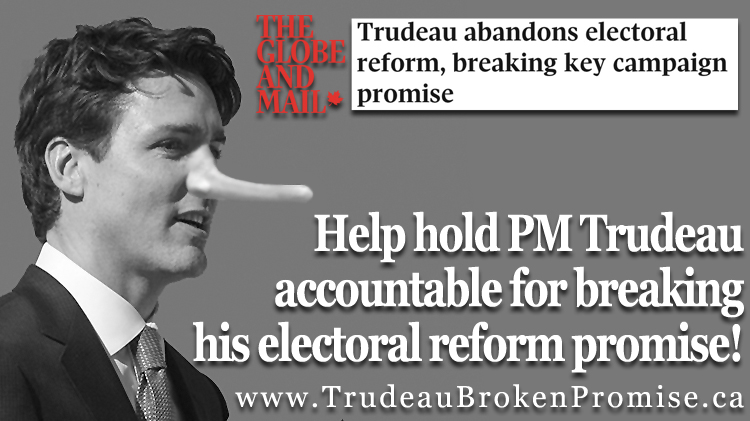
Democracy Watch calls on Commissioner of Canada Elections to rule Prime Minister Trudeau violated federal elections law by baiting voters with false electoral reform election promise

Group’s webpage invites voters to send email to the Commissioner, especially if they were baited to vote for the Liberals by the PM’s false promise

FOR IMMEDIATE RELEASE:
Thursday, February 22, 2018

OTTAWA – Today, Democracy Watch released the letter it sent this morning to federal Commissioner of Canada Elections Yves Côté as it launched its new campaign – http://TrudeauBrokenPromise.ca – that calls on Commissioner Côté to investigate and initiate a prosecution of Prime Minister Trudeau’s dishonest electoral reform election promise made during the 2015 federal election.

Democracy Watch’s campaign page allows voters to send an email to the Commissioner supporting the call for an investigation and prosecution, and to add a line to the email if they were baited to vote for the Liberals by Mr. Trudeau’s false promise.

Set out in the letter to Commissioner Côté is the clear evidence that shows, beyond any reasonable doubt, that Prime Minister Trudeau’s statements and actions violate the rule in the Canada Elections Act that (among other things) prohibits anyone from making a false claim that attempts to convince voters to vote for an election candidate (subsection 482(b)).

In the 2015 federal election campaign, and for some time after, Prime Minister Trudeau promised unequivocally and unconditionally to end the first-past-the-post voting system and replace it with a system that would “Make Every Vote Count.”

“The rule in Canada’s election law makes it clearly illegal to bait voters like Prime Minister Trudeau did in the 2015 federal election with his false promise that the Liberals would change the voting system if they won no matter what, and we hope that the Commissioner of Canada Elections will hold the PM accountable for violating the law,” said Duff Conacher, Co-founder of Democracy Watch. “The rule prohibiting false promises is clearly intended to discourage people from making dishonest promises, and to penalize them in order to protect voters, and elections, from being undermined by unfair tricks.”

The rule prohibiting false promises has never been tested in the courts, and so Democracy Watch’s letter calls on Commissioner Côté, and Director of Public Prosecutions Kathleen Roussel, to let the courts determine the legally correct interpretation and application of the subsection 482(b) rule.

“The courts are the proper place for a determination of whether Prime Minister Trudeau violated the rule prohibiting false promises, and so neither the Commissioner of Elections nor the Director of Public Prosecutions should prevent the prosecution from being heard by the courts,” said Conacher.

Prime Minister Trudeau’s promise to change the voting system was repeated more than 2,000 times and was a key plank in the Liberal Party’s election platform.

After the election, the Special Parliamentary Committee on Electoral Reform (ERRE Committee) was formed and, over a five-month period in 2016, MPs on the Committee heard overwhelming evidence and appeals from thousands of Canadians to change the voting system to one that would reflect proportional representation.

After hearing months of testimony from academics, experts and citizens, the ERRE Committee submitted a majority report based on the recommendations of 180 experts, 107 of whom expressed an opinion on keeping our current system vs. adopting a proportional system.  Fully 88% of these experts called for a proportional system, according to a detailed compilation undertaken by Fair Vote Canada.

This consultation process was the fifteenth of its kind in Canada on the issue of electoral reform.  All, including this consultation, recommended to make the system fairer and more representative by moving to a proportional voting system.

Prime Minister Trudeau ignored all of the evidence and decided arbitrarily that “all forms of proportional representation would be bad for Canada.”  He also made several false statements after breaking his promise.

Prime Minister Trudeau’s many false statements make it very clear that he made his false promise solely to attract voters, and that he never intended to honour it.

– 30 –

FOR MORE INFORMATION, CONTACT:
Duff Conacher, Co-founder of Democracy Watch
Tel: 613-241-5179    Cell: 416-546-3443
Email: [email protected]

Democracy Watch’s Democratic Voting System Campaign and Honesty in Politics Campaign

Group’s webpage invites voters to send email to the Commissioner, especially if they were baited to vote for the Liberals by the PM’s false promise

FOR IMMEDIATE RELEASE:
Thursday, February 22, 2018

OTTAWA – Today, Democracy Watch released the letter it sent this morning to federal Commissioner of Canada Elections Yves Côté as it launched its new campaign – http://TrudeauBrokenPromise.ca – that calls on Commissioner Côté to investigate and initiate a prosecution of Prime Minister Trudeau’s dishonest electoral reform election promise made during the 2015 federal election.

Democracy Watch’s campaign page allows voters to send an email to the Commissioner supporting the call for an investigation and prosecution, and to add a line to the email if they were baited to vote for the Liberals by Mr. Trudeau’s false promise.

Set out in the letter to Commissioner Côté is the clear evidence that shows, beyond any reasonable doubt, that Prime Minister Trudeau’s statements and actions violate the rule in the Canada Elections Act that (among other things) prohibits anyone from making a false claim that attempts to convince voters to vote for an election candidate (subsection 482(b)).

In the 2015 federal election campaign, and for some time after, Prime Minister Trudeau promised unequivocally and unconditionally to end the first-past-the-post voting system and replace it with a system that would “Make Every Vote Count.”

“The rule in Canada’s election law makes it clearly illegal to bait voters like Prime Minister Trudeau did in the 2015 federal election with his false promise that the Liberals would change the voting system if they won no matter what, and we hope that the Commissioner of Canada Elections will hold the PM accountable for violating the law,” said Duff Conacher, Co-founder of Democracy Watch. “The rule prohibiting false promises is clearly intended to discourage people from making dishonest promises, and to penalize them in order to protect voters, and elections, from being undermined by unfair tricks.”

The rule prohibiting false promises has never been tested in the courts, and so Democracy Watch’s letter calls on Commissioner Côté, and Director of Public Prosecutions Kathleen Roussel, to let the courts determine the legally correct interpretation and application of the subsection 482(b) rule.

“The courts are the proper place for a determination of whether Prime Minister Trudeau violated the rule prohibiting false promises, and so neither the Commissioner of Elections nor the Director of Public Prosecutions should prevent the prosecution from being heard by the courts,” said Conacher.

Prime Minister Trudeau’s promise to change the voting system was repeated more than 2,000 times and was a key plank in the Liberal Party’s election platform.

After the election, the Special Parliamentary Committee on Electoral Reform (ERRE Committee) was formed and, over a five-month period in 2016, MPs on the Committee heard overwhelming evidence and appeals from thousands of Canadians to change the voting system to one that would reflect proportional representation.

After hearing months of testimony from academics, experts and citizens, the ERRE Committee submitted a majority report based on the recommendations of 180 experts, 107 of whom expressed an opinion on keeping our current system vs. adopting a proportional system.  Fully 88% of these experts called for a proportional system, according to a detailed compilation undertaken by Fair Vote Canada.

This consultation process was the fifteenth of its kind in Canada on the issue of electoral reform.  All, including this consultation, recommended to make the system fairer and more representative by moving to a proportional voting system.

Prime Minister Trudeau ignored all of the evidence and decided arbitrarily that “all forms of proportional representation would be bad for Canada.”  He also made several false statements after breaking his promise.

Prime Minister Trudeau’s many false statements make it very clear that he made his false promise solely to attract voters, and that he never intended to honour it.

– 30 –

FOR MORE INFORMATION, CONTACT:
Duff Conacher, Co-founder of Democracy Watch
Tel: 613-241-5179    Cell: 416-546-3443
Email: [email protected]

Democracy Watch’s Democratic Voting System Campaign and Honesty in Politics Campaign

Democracy Watch releases legal arguments in court challenge of Ethics Commissioner’s illegal screens

Prime Minister latest to set up a “smokescreen” – his covers up conflicts of interest with Aga Khan

Conservatives changed law to require disclosure when ministers and others recuse themselves from decision-making processes – Ethics Commissioner Mary Dawson ignored the law and allowed screens that hide recusals

New Ethics Commissioner Mario Dion, handpicked by Trudeau Cabinet through secretive process, continues to allow use of screens

FOR IMMEDIATE RELEASE:
Friday, February 9, 2018

OTTAWA – Today, Democracy Watch released its legal arguments in its court challenge of the Ethics Commissioner’s illegal use of screens that hide whether Cabinet ministers or other government official recuse themselves from discussions or decisions when they have a conflict of interest. The first federal Ethics Commissioner, Bernard Shapiro, recommended in 2005 and 2006 that detailed public disclosure be required every time ministers or other officials recuse themselves. With the 2006 Federal Accountability Act, the Conservatives changed the federal ethics law to require public disclosure.

Ethics Commissioner Mary Dawson ignored the law through her entire 2007-2017 term, and instead she set up what she calls conflict of interest “screens” that are actually “smokescreens” as Commissioner Dawson claimed public declarations of recusals were not required by ministers and others with screens.

Prime Minister Trudeau is the latest of more than 20 ministers and top government officials to set up a screen (as new Ethics Commissioner Mario Dion continues to allow office holders to use them). Trudeau’s screen claims he will “abstain from any matter, discussion or decision, other than my participation in activities that are ceremonial in nature, specifically targeting the interests of the Aga Khan and his institutions.”

There is nothing in the federal ethics law, the Conflict of Interest Act, that allows the Ethics Commissioner to use the screens. Subsection 25(1) of the Act requires a public declaration detailing every recusal. In her January 2013 report to the House Ethics Committee, Ethics Commissioner Dawson acknowledged that the definition of “recusal” is broad and covers all the situations that the screens cover (page 35).

“The federal Ethics Commissioner’s smokescreens violate the federal ethics law as they allow Cabinet ministers and others to hide whether they are taking part in decisions when they have a conflict of interest,” said Duff Conacher, Co-founder of Democracy Watch. “The Ethics Commissioner screen schemes ignore that the law was changed in 2006 to require public disclosure every time a minister or government official doesn’t participate in a discussion or decision because of a conflict of interest, as recommended by the first ethics commissioner in 2005 and 2006.”

Democracy Watch recently requested that Ethics Commissioner Mario Dion recuse himself from making any decisions about situations involving the Trudeau Cabinet as he was handpicked by the Cabinet through a secretive process that failed to consult with opposition party leaders as required by law. Democracy Watch has another court case challenging the legality of Dion’s appointment.

More than 11,000 Canadians have signed a petition supporting Democracy Watch’s campaign calling on federal parties to work together to change the appointment process for the Ethics Commissioner, and all officers of Parliament and judicial and watchdog positions, to make it actually merit-based and independent from Cabinet, and to prohibit reappointments.

– 30 –

FOR MORE INFORMATION, CONTACT:
Duff Conacher, Co-founder of Democracy Watch

and Chairperson of the Government Ethics Coalition

Tel: (613) 241-5179
Cell: 416-546-3443
[email protected]

Democracy Watch’s Government Ethics Campaign and Stop Bad Government Appointments Campaign

Prime Minister latest to set up a “smokescreen” – his covers up conflicts of interest with Aga Khan

Conservatives changed law to require disclosure when ministers and others recuse themselves from decision-making processes – Ethics Commissioner Mary Dawson ignored the law and allowed screens that hide recusals

New Ethics Commissioner Mario Dion, handpicked by Trudeau Cabinet through secretive process, continues to allow use of screens

FOR IMMEDIATE RELEASE:
Friday, February 9, 2018

OTTAWA – Today, Democracy Watch released its legal arguments in its court challenge of the Ethics Commissioner’s illegal use of screens that hide whether Cabinet ministers or other government official recuse themselves from discussions or decisions when they have a conflict of interest. The first federal Ethics Commissioner, Bernard Shapiro, recommended in 2005 and 2006 that detailed public disclosure be required every time ministers or other officials recuse themselves. With the 2006 Federal Accountability Act, the Conservatives changed the federal ethics law to require public disclosure.

Ethics Commissioner Mary Dawson ignored the law through her entire 2007-2017 term, and instead she set up what she calls conflict of interest “screens” that are actually “smokescreens” as Commissioner Dawson claimed public declarations of recusals were not required by ministers and others with screens.

Prime Minister Trudeau is the latest of more than 20 ministers and top government officials to set up a screen (as new Ethics Commissioner Mario Dion continues to allow office holders to use them). Trudeau’s screen claims he will “abstain from any matter, discussion or decision, other than my participation in activities that are ceremonial in nature, specifically targeting the interests of the Aga Khan and his institutions.”

There is nothing in the federal ethics law, the Conflict of Interest Act, that allows the Ethics Commissioner to use the screens. Subsection 25(1) of the Act requires a public declaration detailing every recusal. In her January 2013 report to the House Ethics Committee, Ethics Commissioner Dawson acknowledged that the definition of “recusal” is broad and covers all the situations that the screens cover (page 35).

“The federal Ethics Commissioner’s smokescreens violate the federal ethics law as they allow Cabinet ministers and others to hide whether they are taking part in decisions when they have a conflict of interest,” said Duff Conacher, Co-founder of Democracy Watch. “The Ethics Commissioner screen schemes ignore that the law was changed in 2006 to require public disclosure every time a minister or government official doesn’t participate in a discussion or decision because of a conflict of interest, as recommended by the first ethics commissioner in 2005 and 2006.”

Democracy Watch recently requested that Ethics Commissioner Mario Dion recuse himself from making any decisions about situations involving the Trudeau Cabinet as he was handpicked by the Cabinet through a secretive process that failed to consult with opposition party leaders as required by law. Democracy Watch has another court case challenging the legality of Dion’s appointment.

More than 11,000 Canadians have signed a petition supporting Democracy Watch’s campaign calling on federal parties to work together to change the appointment process for the Ethics Commissioner, and all officers of Parliament and judicial and watchdog positions, to make it actually merit-based and independent from Cabinet, and to prohibit reappointments.

– 30 –

FOR MORE INFORMATION, CONTACT:
Duff Conacher, Co-founder of Democracy Watch

and Chairperson of the Government Ethics Coalition

Tel: (613) 241-5179
Cell: 416-546-3443
[email protected]

Democracy Watch’s Government Ethics Campaign and Stop Bad Government Appointments Campaign

Democracy Watch’s lawsuit challenges former Lobbying Commissioner’s ruling that Aga Khan not covered by lobbying law and code so Bahamas trip gift to PM Trudeau was legal

Former Commissioner Karen Shepherd ignored fact that Aga Khan lobbies for his foundation, which is registered to lobby the federal government, and so his gift causes the foundation to violate the Lobbyists’ Code

New Lobbying Commissioner Nancy Bélanger in conflict of interest as she was handpicked by Trudeau through secretive, PMO-controlled process – must refer investigation to person independent of her and all parties or DWatch will also challenge her in court

Auditor General should also audit past Commissioner Shepherd’s extremely weak enforcement records – she let 85% of violators off the hook

Review of federal lobbying laws this year must close secret lobbying loopholes, strengthen enforcement, make Lobbying Commissioner actually independent by changing appointment process, and add high fines as penalties

FOR IMMEDIATE RELEASE:
Tuesday, February 6, 2018

OTTAWA – Today, Democracy Watch released the application it recently filed in Federal Court challenging the ruling last September by former Lobbying Commissioner Karen Shepherd that the Aga Khan is not covered by the federal lobbying law or code, and so his Bahamas trip gift to Prime Minister Trudeau was legal.

Although Commissioner Shepherd’s ruling was made last September, it didn’t become public until CBC reported on December 22nd that someone had complained to the Lobbying Commissioner about the Aga Khan’s trip gift to Trudeau sometime in the past year, and had received the Commissioner’s letter containing the ruling on September 21st. The letter stated even though the Aga Khan is chair of the board of the Aga Khan Foundation, which is registered to lobby the federal government, because he wasn’t paid to lobby for them the Lobbying Act (“Act”) and Lobbyists’ Code of Conduct (“Lobbyists’ Code”) do not apply to him.

Commissioner Shepherd’s ruling has still not been made public – Democracy Watch has requested in its lawsuit that the Office of the Commissioner of Lobbying make the ruling public (while keeping the complainant’s identity anonymous as their identity is irrelevant to the case). Commissioner Shepherd made the ruling while serving on a six-month, sole-source, renewable contract handed to her by the Trudeau Cabinet – a contract that Democracy Watch challenged in court because it was illegal and made her biased (Democracy Watch has withdrawn that court case given that a new Lobbying Commissioner and Ethics Commissioner were appointed in December).

Among other rules, rules 6, 8 and 10 of the Lobbyists’ Code prohibit people who should be registered as lobbyists from doing anything significant for, or giving anything significant to, anyone they are lobbying. It also requires people who should be registered as lobbyists to follow the spirit of the Code and the Act.

The error of the Commissioner’s ruling is that the Aga Khan lobbies the Prime Minister and other federal government institutions and officials and politicians not for himself but for the Aga Khan Foundation. As well, as head of the board of the Foundation, he is legally bound to advance the interests of the Foundation, and likely at least some of his expenses are covered by the Foundation. As a result, whether he is paid or not, he should be considered by the Commissioner to be covered by the Act and the Lobbyists’ Code and his gift to the Prime Minister should have resulted in a ruling that the Foundation violated the rules in the Code that prohibit such gifts.

“Democracy Watch is challenging the Lobbying Commissioner’s ruling in court because it is legally incorrect, violates the spirit and purpose of the Lobbyists’ Code of Conduct, and opens up a huge loophole that big businesses and other organizations will exploit by having their unregistered board members or staff do favours for, and give gifts to, politicians and government officials they are lobbying as a way of unethically influencing their policy making decisions,” said Duff Conacher, Co-founder of Democracy Watch. “Democracy Watch is also challenging Commissioner Shepherd’s ruling because she was on a six-month, sole-source, renewable contract handed to her by the Trudeau Cabinet at the time she made the ruling, and so she lacked independence and was biased in favour of the Cabinet.”

On December 20th, before it became public that Commissioner Shepherd had made the ruling last September, Democracy Watch filed a complaint with new Lobbying Commissioner Nancy Bélanger alleging the Aga Khan’s gift of the Bahamas trip given to Prime Minister Trudeau in December 2014 and December 2016, and to Liberal MP Seamus O’Regan in December 2016, violated the Lobbyists’ Code of Conduct. The office of the Lobbying Commissioner confirmed on December 28th that it was investigating Democracy Watch’s complaint.

Democracy Watch requested in its complaint letter that that the complaint be investigated and ruled on by someone completely independent of Commissioner Bélanger because she was handpicked by Prime Minister Trudeau through a secretive, PMO-controlled process and is therefore biased. In a separate court case, Democracy Watch is challenging Trudeau’s appointment of Commissioner Bélanger, and Democracy Watch also has an ongoing campaign to make the Cabinet appointment process actually independent, open and merit-based.

“An independent investigation about whether the Aga Khan a year ago violated the lobbyist ethics code by giving the trip gift to PM Trudeau and MP O’Regan should have been initiated a year ago,” said Duff Conacher, Co-founder of Democracy Watch. “Given that she was handpicked by Trudeau through a secretive, PMO-controlled process, the new Lobbying Commissioner is in a conflict of interest and so must delegate the investigation to a person who is independent of her and all federal political parties.”

Democracy Watch is also calling on the Auditor General to audit Lobbying Commissioner Shepherd and the RCMP because they let off the hook 84% of people who she caught since 2008 violating the Act or Lobbyists’ Code. Commissioner Shepherd finished her term in office on December 29th. Hundreds of Canadians have joined the call on the Auditor General to audit the Ethics Commissioner and Lobbying Commissioner and RCMP — see details here.

“Lobbying Commissioner Shepherd went out with a whimper by issuing only one public ruling in the past two years since the Liberals were elected, and she also let almost everyone off since 2008 so the Auditor General should also audit her negligently weak record,” said Conacher.

The Conflict of Interest Act and the Lobbying Act and Lobbyists’ Code are required to be reviewed by the House Ethics Committee in 2018. The Conservatives rejected many key proposed changes when the laws were last reviewed by the Committee. See details about the changes needed to close loopholes and strengthen enforcement and penalties for the Lobbying Act and Lobbyists’ Code of Conduct here.

– 30 –

FOR MORE INFORMATION, CONTACT:
Duff Conacher, Co-founder of Democracy Watch
Tel: (613) 241-5179 Cell: 416-546-3443
[email protected]

Democracy Watch’s Government Ethics Campaign page and Stop Bad Government Appointments Campaign page

Former Commissioner Karen Shepherd ignored fact that Aga Khan lobbies for his foundation, which is registered to lobby the federal government, and so his gift causes the foundation to violate the Lobbyists’ Code

New Lobbying Commissioner Nancy Bélanger in conflict of interest as she was handpicked by Trudeau through secretive, PMO-controlled process – must refer investigation to person independent of her and all parties or DWatch will also challenge her in court

Auditor General should also audit past Commissioner Shepherd’s extremely weak enforcement records – she let 85% of violators off the hook

Review of federal lobbying laws this year must close secret lobbying loopholes, strengthen enforcement, make Lobbying Commissioner actually independent by changing appointment process, and add high fines as penalties

FOR IMMEDIATE RELEASE:
Tuesday, February 6, 2018

OTTAWA – Today, Democracy Watch released the application it recently filed in Federal Court challenging the ruling last September by former Lobbying Commissioner Karen Shepherd that the Aga Khan is not covered by the federal lobbying law or code, and so his Bahamas trip gift to Prime Minister Trudeau was legal.

Although Commissioner Shepherd’s ruling was made last September, it didn’t become public until CBC reported on December 22nd that someone had complained to the Lobbying Commissioner about the Aga Khan’s trip gift to Trudeau sometime in the past year, and had received the Commissioner’s letter containing the ruling on September 21st. The letter stated even though the Aga Khan is chair of the board of the Aga Khan Foundation, which is registered to lobby the federal government, because he wasn’t paid to lobby for them the Lobbying Act (“Act”) and Lobbyists’ Code of Conduct (“Lobbyists’ Code”) do not apply to him.

Commissioner Shepherd’s ruling has still not been made public – Democracy Watch has requested in its lawsuit that the Office of the Commissioner of Lobbying make the ruling public (while keeping the complainant’s identity anonymous as their identity is irrelevant to the case). Commissioner Shepherd made the ruling while serving on a six-month, sole-source, renewable contract handed to her by the Trudeau Cabinet – a contract that Democracy Watch challenged in court because it was illegal and made her biased (Democracy Watch has withdrawn that court case given that a new Lobbying Commissioner and Ethics Commissioner were appointed in December).

Among other rules, rules 6, 8 and 10 of the Lobbyists’ Code prohibit people who should be registered as lobbyists from doing anything significant for, or giving anything significant to, anyone they are lobbying. It also requires people who should be registered as lobbyists to follow the spirit of the Code and the Act.

The error of the Commissioner’s ruling is that the Aga Khan lobbies the Prime Minister and other federal government institutions and officials and politicians not for himself but for the Aga Khan Foundation. As well, as head of the board of the Foundation, he is legally bound to advance the interests of the Foundation, and likely at least some of his expenses are covered by the Foundation. As a result, whether he is paid or not, he should be considered by the Commissioner to be covered by the Act and the Lobbyists’ Code and his gift to the Prime Minister should have resulted in a ruling that the Foundation violated the rules in the Code that prohibit such gifts.

“Democracy Watch is challenging the Lobbying Commissioner’s ruling in court because it is legally incorrect, violates the spirit and purpose of the Lobbyists’ Code of Conduct, and opens up a huge loophole that big businesses and other organizations will exploit by having their unregistered board members or staff do favours for, and give gifts to, politicians and government officials they are lobbying as a way of unethically influencing their policy making decisions,” said Duff Conacher, Co-founder of Democracy Watch. “Democracy Watch is also challenging Commissioner Shepherd’s ruling because she was on a six-month, sole-source, renewable contract handed to her by the Trudeau Cabinet at the time she made the ruling, and so she lacked independence and was biased in favour of the Cabinet.”

On December 20th, before it became public that Commissioner Shepherd had made the ruling last September, Democracy Watch filed a complaint with new Lobbying Commissioner Nancy Bélanger alleging the Aga Khan’s gift of the Bahamas trip given to Prime Minister Trudeau in December 2014 and December 2016, and to Liberal MP Seamus O’Regan in December 2016, violated the Lobbyists’ Code of Conduct. The office of the Lobbying Commissioner confirmed on December 28th that it was investigating Democracy Watch’s complaint.

Democracy Watch requested in its complaint letter that that the complaint be investigated and ruled on by someone completely independent of Commissioner Bélanger because she was handpicked by Prime Minister Trudeau through a secretive, PMO-controlled process and is therefore biased. In a separate court case, Democracy Watch is challenging Trudeau’s appointment of Commissioner Bélanger, and Democracy Watch also has an ongoing campaign to make the Cabinet appointment process actually independent, open and merit-based.

“An independent investigation about whether the Aga Khan a year ago violated the lobbyist ethics code by giving the trip gift to PM Trudeau and MP O’Regan should have been initiated a year ago,” said Duff Conacher, Co-founder of Democracy Watch. “Given that she was handpicked by Trudeau through a secretive, PMO-controlled process, the new Lobbying Commissioner is in a conflict of interest and so must delegate the investigation to a person who is independent of her and all federal political parties.”

Democracy Watch is also calling on the Auditor General to audit Lobbying Commissioner Shepherd and the RCMP because they let off the hook 84% of people who she caught since 2008 violating the Act or Lobbyists’ Code. Commissioner Shepherd finished her term in office on December 29th. Hundreds of Canadians have joined the call on the Auditor General to audit the Ethics Commissioner and Lobbying Commissioner and RCMP — see details here.

“Lobbying Commissioner Shepherd went out with a whimper by issuing only one public ruling in the past two years since the Liberals were elected, and she also let almost everyone off since 2008 so the Auditor General should also audit her negligently weak record,” said Conacher.

The Conflict of Interest Act and the Lobbying Act and Lobbyists’ Code are required to be reviewed by the House Ethics Committee in 2018. The Conservatives rejected many key proposed changes when the laws were last reviewed by the Committee. See details about the changes needed to close loopholes and strengthen enforcement and penalties for the Lobbying Act and Lobbyists’ Code of Conduct here.

– 30 –

FOR MORE INFORMATION, CONTACT:
Duff Conacher, Co-founder of Democracy Watch
Tel: (613) 241-5179 Cell: 416-546-3443
[email protected]

Democracy Watch’s Government Ethics Campaign page and Stop Bad Government Appointments Campaign page

Democracy Watch requests that new Ethics Commissioner not make any decisions affecting Liberals because of bias

Trudeau Cabinet put new Ethics Commissioner in a conflict of interest by handpicking him through a secretive, PMO-controlled process that failed to consult with opposition parties as required – DWatch sent similar letter last week to new Lobbying Commissioner who was also handpicked by Cabinet

New Ethics Commissioner Mario Dion also has a negligently weak enforcement record that makes him unfit for the job

More than 11,000 Canadians have called for key changes to make the Cabinet appointment process actually open, independent and merit-based

FOR IMMEDIATE RELEASE:
Tuesday, January 30, 2018

OTTAWA – Democracy Watch released the letter it sent today to new federal Ethics Commissioner Mario Dion requesting that he not make any decisions concerning investigations of situations involving the Trudeau Cabinet or Liberals because the Cabinet created a conflict of interest for him by handpicking him through a secretive, PMO-controlled process. As well, the Cabinet failed to consult with opposition party leaders before making his appointment as required by the Parliament of Canada Act.

As a result, Commissioner Dion has an appearance of bias that taints any decision he may make, including decisions he may make about Bill Morneau’s involvement in discussions and decisions concerning Bill C-27. It is not known how many other current situations the Ethics Commissioner is investigating that involve the Trudeau Cabinet or Liberals.

On January 25th, Democracy Watch sent a similar letter to new Lobbying Commissioner Nancy Bélanger, who that same day sent a decision to Democracy Watch stating that she was ending the investigations into both fundraising events for the Liberals that Barry Sherman was involved in because Mr. Sherman passed away recently. Because of her bias, and also because her decision is legally incorrect, Democracy Watch will soon file court cases challenging the Commissioner’s decisions.

On January 15th, Democracy Watch filed an application in Federal Court challenging the appointment of the new Lobbying Commissioner by the Trudeau Cabinet because of the failure to consult with opposition party leaders, and because the Cabinet was in a conflict of interest as the Ethics Commissioner was investigating situations involving Prime Minister Trudeau and other Cabinet ministers at the time the appointment was made.

To allow the investigations into Democracy Watch’s complaints to continue, Democracy Watch proposes that Ethics Commissioner Dion delegate the situations to a provincial commissioner who is independent of her, the Trudeau Cabinet, and all federal political parties. This process has been used at the provincial level by ethics commissioners. For example, in 2016 Marguerite Trussler, Alberta’s Ethics Commissioner, recused herself from investigating and ruling on a complaint because she was friends with two people involved in the matter.

“The Trudeau Cabinet put the new Ethics Commissioner in a conflict of interest by handpicking him through a secretive, PMO-controlled process, and as a result the Commissioner is tainted by bias and must not rule on any situations involving the Trudeau Cabinet or Liberals,” said Duff Conacher, Co-founder of Democracy Watch and Adjunct Professor of Law and Political Science at the University of Ottawa.

“It would be a clear conflict of interest if someone sued Prime Minister Trudeau or a Cabinet minister and the Cabinet chose which judge would hear the case, and it is just as clearly a conflict of interest for the Cabinet to choose the new Ethics Commissioner when he is judging whether the PM and other Cabinet ministers are involved in illegal situations,” said Conacher.

In addition, Ethics Commissioner Dion has a record of eight unethical and questionable actions in his previous position as Integrity Commissioner – a record that makes him unfit for the position of Ethics Commissioner.

More than 11,000 Canadians have signed a petition supporting Democracy Watch’s Stop Bad Government Appointments Campaign calling on federal parties to work together to change the appointment process for all officers of Parliament and judicial and watchdog positions, to make it actually merit-based and independent from Cabinet, and to prohibit reappointments.

For many appointments, including of the new Ethics Commissioner and Lobbying Commissioner, the Trudeau Cabinet continues to use the same secretive, PMO-controlled, partisan process that past governments used.

– 30 –

FOR MORE INFORMATION, CONTACT:
Duff Conacher, Co-founder of Democracy Watch
and Chairperson of the Government Ethics Coalition
Tel: (613) 241-5179
Cell: 416-546-3443
[email protected]

Democracy Watch’s Stop Bad Government Appointments Campaign and Government Ethics Campaign

Trudeau Cabinet put new Ethics Commissioner in a conflict of interest by handpicking him through a secretive, PMO-controlled process that failed to consult with opposition parties as required – DWatch sent similar letter last week to new Lobbying Commissioner who was also handpicked by Cabinet

New Ethics Commissioner Mario Dion also has a negligently weak enforcement record that makes him unfit for the job

More than 11,000 Canadians have called for key changes to make the Cabinet appointment process actually open, independent and merit-based

FOR IMMEDIATE RELEASE:
Tuesday, January 30, 2018

OTTAWA – Democracy Watch released the letter it sent today to new federal Ethics Commissioner Mario Dion requesting that he not make any decisions concerning investigations of situations involving the Trudeau Cabinet or Liberals because the Cabinet created a conflict of interest for him by handpicking him through a secretive, PMO-controlled process. As well, the Cabinet failed to consult with opposition party leaders before making his appointment as required by the Parliament of Canada Act.

As a result, Commissioner Dion has an appearance of bias that taints any decision he may make, including decisions he may make about Bill Morneau’s involvement in discussions and decisions concerning Bill C-27. It is not known how many other current situations the Ethics Commissioner is investigating that involve the Trudeau Cabinet or Liberals.

On January 25th, Democracy Watch sent a similar letter to new Lobbying Commissioner Nancy Bélanger, who that same day sent a decision to Democracy Watch stating that she was ending the investigations into both fundraising events for the Liberals that Barry Sherman was involved in because Mr. Sherman passed away recently. Because of her bias, and also because her decision is legally incorrect, Democracy Watch will soon file court cases challenging the Commissioner’s decisions.

On January 15th, Democracy Watch filed an application in Federal Court challenging the appointment of the new Lobbying Commissioner by the Trudeau Cabinet because of the failure to consult with opposition party leaders, and because the Cabinet was in a conflict of interest as the Ethics Commissioner was investigating situations involving Prime Minister Trudeau and other Cabinet ministers at the time the appointment was made.

To allow the investigations into Democracy Watch’s complaints to continue, Democracy Watch proposes that Ethics Commissioner Dion delegate the situations to a provincial commissioner who is independent of her, the Trudeau Cabinet, and all federal political parties. This process has been used at the provincial level by ethics commissioners. For example, in 2016 Marguerite Trussler, Alberta’s Ethics Commissioner, recused herself from investigating and ruling on a complaint because she was friends with two people involved in the matter.

“The Trudeau Cabinet put the new Ethics Commissioner in a conflict of interest by handpicking him through a secretive, PMO-controlled process, and as a result the Commissioner is tainted by bias and must not rule on any situations involving the Trudeau Cabinet or Liberals,” said Duff Conacher, Co-founder of Democracy Watch and Adjunct Professor of Law and Political Science at the University of Ottawa.

“It would be a clear conflict of interest if someone sued Prime Minister Trudeau or a Cabinet minister and the Cabinet chose which judge would hear the case, and it is just as clearly a conflict of interest for the Cabinet to choose the new Ethics Commissioner when he is judging whether the PM and other Cabinet ministers are involved in illegal situations,” said Conacher.

In addition, Ethics Commissioner Dion has a record of eight unethical and questionable actions in his previous position as Integrity Commissioner – a record that makes him unfit for the position of Ethics Commissioner.

More than 11,000 Canadians have signed a petition supporting Democracy Watch’s Stop Bad Government Appointments Campaign calling on federal parties to work together to change the appointment process for all officers of Parliament and judicial and watchdog positions, to make it actually merit-based and independent from Cabinet, and to prohibit reappointments.

For many appointments, including of the new Ethics Commissioner and Lobbying Commissioner, the Trudeau Cabinet continues to use the same secretive, PMO-controlled, partisan process that past governments used.

– 30 –

FOR MORE INFORMATION, CONTACT:
Duff Conacher, Co-founder of Democracy Watch
and Chairperson of the Government Ethics Coalition
Tel: (613) 241-5179
Cell: 416-546-3443
[email protected]

Democracy Watch’s Stop Bad Government Appointments Campaign and Government Ethics Campaign

Bill C-65 just nice words on paper – to actually protect workers Trudeau government needs to implement House Committee recommendations to strengthen protection of all workers in federal politics, and also extend protection to whistleblowers who work in federal businesses

Treasury Board minister Scott Brison’s letter in October rejected the House Committee’s recommendations – and Bill C-65 doesn’t change Canada Labour Code requirement that everyone complain, unprotected, to their boss

Public Sector Integrity Commissioner Joe Friday should be fired as he has been found guilty three times by Federal Court of violating whistleblowers rights

Governments across Canada need to make all the changes needed to ensure government and business whistleblowers are fully protected, as banking and airline scandals show

FOR IMMEDIATE RELEASE:
Monday, January 29, 2018

OTTAWA – Today, Democracy Watch called on the federal Liberals to make the protections from harassment and assault in Bill C-65 actually effective by extending whistleblower protection to all federal workplaces, including Parliament. Bill C-65 does nothing to change the Canada Labour Code’s requirement that federal workplace victims file complaints with their boss, who is often the harasser.

As some commentators have pointed out, the federal House of Commons and Senate harassment complaint systems are secretive and rigged in favour of covering up wrongdoing.

Last June’s report released by the House of Commons Government Operations Committee called for many key changes to change the law and enforcement system to strengthen protection for whistleblowers who report wrongdoing by people in the federal government. However, Treasury Board Minister Scott Brison rejected the Committee’s recommendations in an October letter – committing the government only to reinforcing the internal disclosure process.

Democracy Watch appeared before the Committee twice, and its submission included the Change.org petition that more than 21,000 voters signed calling for 17 key changes by the federal government to protect people who blow the whistle on government and big business abuse, waste and law-breaking. As the current banking service scandal and airline service scandals show, such protection is much needed.

“The committee unanimously recommended many key changes to strengthen protection for people who blow the whistle on wrongdoing in the federal government but the Trudeau Liberals rejected the recommendations and continue to let people in federal politics who do wrong threaten and attack people who try to disclose their wrongdoing,” said Duff Conacher, Co-founder of Democracy Watch. “The committee, public sector unions and citizen watchdog groups are unanimously calling for key changes to strengthen whistleblower protection, as are tens of thousands of voters who have signed a national petition, so there is no reason for the Liberals to delay making these changes, including to Bill C-65.”

Democracy Watch also called on Parliament to fire Public Sector Integrity Commissioner Joe Friday who, for the third time, was found guilty in December by the Federal Court of violating a whistleblower’s rights.

“The federal Liberals claimed in their 2015 election platform that greater openness and transparency are fundamental to restoring trust in Canada’s democracy but if they don’t strengthen whistleblower protection and use an independent process to appoint a new, effective Integrity Commissioner, they will break their open government promise,” said Conacher.

“Unfortunately, the committee did not recommend any changes to strengthen protection for whistleblowers who work for federal politicians or for businesses that are regulated by the federal government, and the Liberals also need to make those changes to help stop the widespread, serious wrongdoing and abuse caused by politicians and people in Canada’s big banks and other financial institutions, and in airlines, phone, cable TV, food, mining and forestry companies,” said Conacher.

The key changes the Committee recommended include: ensuring everyone involved in federal government operations is covered by the protection law and system (including anyone who helps a whistleblower or is a witness); allowing everyone to file their complaint about retaliation directly with the Public Servants Disclosure Protection Tribunal (instead of having to go to the Public Sector Integrity Commissioner first) up to 12 months after the retaliation (the current deadline is 60 days); requiring the employer to prove that they didn’t retaliate against a whistleblower (currently the whistleblower has to prove retaliation has occurred); ensuring the Integrity Commissioner is fully independently appointed and empowered to impose penalties; requiring the Integrity Commissioner rule on all complaints publicly in a timely manner, and to report more details about complaint handling; requiring the Office of the Chief Human Resources Officer to conduct regular audits of the whole protection system and; empowering the Integrity Commissioner and Tribunal to compensate whistleblowers for legal advice, and rewarding them adequately if their claims are proven.

“The committee should have also recommended requiring disclosure of the identity of all wrongdoers because the public has a right to know when one of their government’s employees does wrong,” said Conacher.

People have tried to protect Canadians by blowing the whistle on governments wasting billions of dollars, approving dangerous drugs, and covering up scandals, and on big businesses gouging them, selling them hazardous products, and covering up pollution and oil spills.

These whistleblowers have been harassed, fired from their jobs, sued, silenced and hurt by governments and big businesses – all because Canadian whistleblower protection laws are weak and enforcement is negligently bad.

The federal Liberals failed to include any promises to strengthen whistleblower protection in their 2015 election platform. The federal Conservatives did little to strengthen whistleblower protection from 2006 to 2015, and actually covered up scandals involving the Public Sector Integrity Commissioner (who enforces the federal law). Other federal parties have done little to push for key changes.

Provincial governments across Canada have also failed to protect government and business whistleblowers fully and effectively, although the Ontario Securities Commission took a big step forward in protecting securities law whistleblowers with a new program launched in July 2016 which offers up to $5 million as a reward for whistleblowers whose claims are proven (which has led to calls to reward securities law whistleblowers in other provinces and to reward Competition Act whistleblowers).

Democracy Watch will continue its ProtectWhistleblowers.ca letter-writing campaign and petition until these changes are made across Canada.

– 30 –

FOR MORE INFORMATION, CONTACT:
Duff Conacher, Co-founder of Democracy Watch
Tel: 613-241-5179 Cell: 416-546-3443
[email protected]

Democracy Watch’s Protect Whistleblowers Who Protect You Campaign


Treasury Board minister Scott Brison’s letter in October rejected the House Committee’s recommendations – and Bill C-65 doesn’t change Canada Labour Code requirement that everyone complain, unprotected, to their boss

Public Sector Integrity Commissioner Joe Friday should be fired as he has been found guilty three times by Federal Court of violating whistleblowers rights

Governments across Canada need to make all the changes needed to ensure government and business whistleblowers are fully protected, as banking and airline scandals show

FOR IMMEDIATE RELEASE:
Monday, January 29, 2018

OTTAWA – Today, Democracy Watch called on the federal Liberals to make the protections from harassment and assault in Bill C-65 actually effective by extending whistleblower protection to all federal workplaces, including Parliament. Bill C-65 does nothing to change the Canada Labour Code’s requirement that federal workplace victims file complaints with their boss, who is often the harasser.

As some commentators have pointed out, the federal House of Commons and Senate harassment complaint systems are secretive and rigged in favour of covering up wrongdoing.

Last June’s report released by the House of Commons Government Operations Committee called for many key changes to change the law and enforcement system to strengthen protection for whistleblowers who report wrongdoing by people in the federal government. However, Treasury Board Minister Scott Brison rejected the Committee’s recommendations in an October letter – committing the government only to reinforcing the internal disclosure process.

Democracy Watch appeared before the Committee twice, and its submission included the Change.org petition that more than 21,000 voters signed calling for 17 key changes by the federal government to protect people who blow the whistle on government and big business abuse, waste and law-breaking. As the current banking service scandal and airline service scandals show, such protection is much needed.

“The committee unanimously recommended many key changes to strengthen protection for people who blow the whistle on wrongdoing in the federal government but the Trudeau Liberals rejected the recommendations and continue to let people in federal politics who do wrong threaten and attack people who try to disclose their wrongdoing,” said Duff Conacher, Co-founder of Democracy Watch. “The committee, public sector unions and citizen watchdog groups are unanimously calling for key changes to strengthen whistleblower protection, as are tens of thousands of voters who have signed a national petition, so there is no reason for the Liberals to delay making these changes, including to Bill C-65.”

Democracy Watch also called on Parliament to fire Public Sector Integrity Commissioner Joe Friday who, for the third time, was found guilty in December by the Federal Court of violating a whistleblower’s rights.

“The federal Liberals claimed in their 2015 election platform that greater openness and transparency are fundamental to restoring trust in Canada’s democracy but if they don’t strengthen whistleblower protection and use an independent process to appoint a new, effective Integrity Commissioner, they will break their open government promise,” said Conacher.

“Unfortunately, the committee did not recommend any changes to strengthen protection for whistleblowers who work for federal politicians or for businesses that are regulated by the federal government, and the Liberals also need to make those changes to help stop the widespread, serious wrongdoing and abuse caused by politicians and people in Canada’s big banks and other financial institutions, and in airlines, phone, cable TV, food, mining and forestry companies,” said Conacher.

The key changes the Committee recommended include: ensuring everyone involved in federal government operations is covered by the protection law and system (including anyone who helps a whistleblower or is a witness); allowing everyone to file their complaint about retaliation directly with the Public Servants Disclosure Protection Tribunal (instead of having to go to the Public Sector Integrity Commissioner first) up to 12 months after the retaliation (the current deadline is 60 days); requiring the employer to prove that they didn’t retaliate against a whistleblower (currently the whistleblower has to prove retaliation has occurred); ensuring the Integrity Commissioner is fully independently appointed and empowered to impose penalties; requiring the Integrity Commissioner rule on all complaints publicly in a timely manner, and to report more details about complaint handling; requiring the Office of the Chief Human Resources Officer to conduct regular audits of the whole protection system and; empowering the Integrity Commissioner and Tribunal to compensate whistleblowers for legal advice, and rewarding them adequately if their claims are proven.

“The committee should have also recommended requiring disclosure of the identity of all wrongdoers because the public has a right to know when one of their government’s employees does wrong,” said Conacher.

People have tried to protect Canadians by blowing the whistle on governments wasting billions of dollars, approving dangerous drugs, and covering up scandals, and on big businesses gouging them, selling them hazardous products, and covering up pollution and oil spills.

These whistleblowers have been harassed, fired from their jobs, sued, silenced and hurt by governments and big businesses – all because Canadian whistleblower protection laws are weak and enforcement is negligently bad.

The federal Liberals failed to include any promises to strengthen whistleblower protection in their 2015 election platform. The federal Conservatives did little to strengthen whistleblower protection from 2006 to 2015, and actually covered up scandals involving the Public Sector Integrity Commissioner (who enforces the federal law). Other federal parties have done little to push for key changes.

Provincial governments across Canada have also failed to protect government and business whistleblowers fully and effectively, although the Ontario Securities Commission took a big step forward in protecting securities law whistleblowers with a new program launched in July 2016 which offers up to $5 million as a reward for whistleblowers whose claims are proven (which has led to calls to reward securities law whistleblowers in other provinces and to reward Competition Act whistleblowers).

Democracy Watch will continue its ProtectWhistleblowers.ca letter-writing campaign and petition until these changes are made across Canada.

– 30 –

FOR MORE INFORMATION, CONTACT:
Duff Conacher, Co-founder of Democracy Watch
Tel: 613-241-5179 Cell: 416-546-3443
[email protected]

Democracy Watch’s Protect Whistleblowers Who Protect You Campaign


Democracy Watch requests that new Lobbying Commissioner not make any decisions affecting Liberals because of bias

Prime Minister Trudeau and his Cabinet put new Lobbying Commissioner in a conflict of interest by handpicking her through a secretive, PMO-controlled process that failed to consult with opposition parties as required

More than 11,000 Canadians have called for key changes to make the Cabinet appointment process actually open, independent and merit-based

NOTE: This morning, the new Lobbying Commissioner Nancy Bélanger sent Democracy Watch a letter stating that she will not continue the investigations into its complaints about two fundraising events for the Liberal Party of Canada that Barry Sherman, former Chair of Apotex Inc. was involved in organizing and hosting. This is exactly the kind of decision that a biased Lobbying Commissioner would make as it is exactly the decision the Trudeau Liberal Cabinet would want. Democracy Watch will challenge Commissioner Bélanger’s decisions in court on the basis that she is biased and her decisions are legally incorrect.

FOR IMMEDIATE RELEASE:
Thursday, January 25, 2018

OTTAWA – Democracy Watch released the letter it sent today to new federal Lobbying Commissioner Nancy Bélanger requesting that she not make any decisions concerning investigations of situations involving the Trudeau Cabinet or Liberals because the Cabinet created a conflict of interest for her by handpicking her through a secretive, PMO-controlled process. As well, the Cabinet failed to consult with opposition party leaders before making her appointment as required by the Lobbying Act.

As a result, Commissioner Bélanger has an appearance of bias that taints any decision she may make, including the decision she has stated she will make by February 2nd about whether she will continue the investigation into Democracy Watch’s complaint alleging that Barry Sherman, Chair of Apotex until he passed away recently, violated rules in the Lobbyists Code of Conduct by hosting an August 2015 fundraising event at his home that Justin Trudeau attended.

In addition to the Barry Sherman/Apotex fundraising event complaint, the office of the Commissioner of Lobbying is investigating four other Democracy Watch complaints about situations involving Prime Minister Trudeau or other Cabinet ministers (See the five situations summarized under A.1 here). Democracy Watch’s letter requests that Commissioner Bélanger not make any decisions concerning any of the five situations or any other situation involving the Trudeau Cabinet or Liberals.

On January 15th, Democracy Watch filed an application in Federal Court challenging the appointment of the new Lobbying Commissioner by the Trudeau Cabinet because of the failure to consult with opposition party leaders, and because the Cabinet was in a conflict of interest as the office of the Lobbying Commissioner was investigating situations involving Prime Minister Trudeau and other Cabinet ministers at the time the appointment was made.

To allow the investigations into Democracy Watch’s complaints to continue, Democracy Watch proposes that Commissioner Bélanger delegate the situations to a provincial commissioner who is independent of her, the Trudeau Cabinet, and all federal political parties. This process has been used at the provincial level by ethics commissioners. For example, in 2016 Marguerite Trussler, Alberta’s Ethics Commissioner, recused herself from investigating and ruling on a complaint because she was friends with two people involved in the matter.

“The Trudeau Cabinet put the new Lobbying Commissioner in a conflict of interest by handpicking her through a secretive, PMO-controlled process, and as a result the Commissioner is tainted by bias and must not rule on any situations involving the Trudeau Cabinet or Liberals,” said Duff Conacher, Co-founder of Democracy Watch and Adjunct Professor of Law and Political Science at the University of Ottawa.

“It would be a clear conflict of interest if someone sued Prime Minister Trudeau or a Cabinet minister and the Cabinet chose which judge would hear the case, and it is just as clearly a conflict of interest for the Cabinet to choose the new Lobbying Commissioner when she is judging whether the PM and other Cabinet ministers are involved in illegal situations,” said Conacher.

More than 11,000 Canadians have signed a petition supporting Democracy Watch’s Stop Bad Government Appointments Campaign calling on federal parties to work together to change the appointment process for all officers of Parliament and judicial and watchdog positions, to make it actually merit-based and independent from Cabinet, and to prohibit reappointments.

For many appointments, including of the new Ethics Commissioner and Lobbying Commissioner, the Trudeau Cabinet continues to use the same secretive, PMO-controlled, partisan process that past governments used.

– 30 –

FOR MORE INFORMATION, CONTACT:
Duff Conacher, Co-founder of Democracy Watch
and Chairperson of the Government Ethics Coalition
Tel: (613) 241-5179
Cell: 416-546-3443
[email protected]

Democracy Watch’s Stop Bad Government Appointments Campaign and Government Ethics Campaign

Prime Minister Trudeau and his Cabinet put new Lobbying Commissioner in a conflict of interest by handpicking her through a secretive, PMO-controlled process that failed to consult with opposition parties as required

More than 11,000 Canadians have called for key changes to make the Cabinet appointment process actually open, independent and merit-based

NOTE: This morning, the new Lobbying Commissioner Nancy Bélanger sent Democracy Watch a letter stating that she will not continue the investigations into its complaints about two fundraising events for the Liberal Party of Canada that Barry Sherman, former Chair of Apotex Inc. was involved in organizing and hosting. This is exactly the kind of decision that a biased Lobbying Commissioner would make as it is exactly the decision the Trudeau Liberal Cabinet would want. Democracy Watch will challenge Commissioner Bélanger’s decisions in court on the basis that she is biased and her decisions are legally incorrect.

FOR IMMEDIATE RELEASE:
Thursday, January 25, 2018

OTTAWA – Democracy Watch released the letter it sent today to new federal Lobbying Commissioner Nancy Bélanger requesting that she not make any decisions concerning investigations of situations involving the Trudeau Cabinet or Liberals because the Cabinet created a conflict of interest for her by handpicking her through a secretive, PMO-controlled process. As well, the Cabinet failed to consult with opposition party leaders before making her appointment as required by the Lobbying Act.

As a result, Commissioner Bélanger has an appearance of bias that taints any decision she may make, including the decision she has stated she will make by February 2nd about whether she will continue the investigation into Democracy Watch’s complaint alleging that Barry Sherman, Chair of Apotex until he passed away recently, violated rules in the Lobbyists Code of Conduct by hosting an August 2015 fundraising event at his home that Justin Trudeau attended.

In addition to the Barry Sherman/Apotex fundraising event complaint, the office of the Commissioner of Lobbying is investigating four other Democracy Watch complaints about situations involving Prime Minister Trudeau or other Cabinet ministers (See the five situations summarized under A.1 here). Democracy Watch’s letter requests that Commissioner Bélanger not make any decisions concerning any of the five situations or any other situation involving the Trudeau Cabinet or Liberals.

On January 15th, Democracy Watch filed an application in Federal Court challenging the appointment of the new Lobbying Commissioner by the Trudeau Cabinet because of the failure to consult with opposition party leaders, and because the Cabinet was in a conflict of interest as the office of the Lobbying Commissioner was investigating situations involving Prime Minister Trudeau and other Cabinet ministers at the time the appointment was made.

To allow the investigations into Democracy Watch’s complaints to continue, Democracy Watch proposes that Commissioner Bélanger delegate the situations to a provincial commissioner who is independent of her, the Trudeau Cabinet, and all federal political parties. This process has been used at the provincial level by ethics commissioners. For example, in 2016 Marguerite Trussler, Alberta’s Ethics Commissioner, recused herself from investigating and ruling on a complaint because she was friends with two people involved in the matter.

“The Trudeau Cabinet put the new Lobbying Commissioner in a conflict of interest by handpicking her through a secretive, PMO-controlled process, and as a result the Commissioner is tainted by bias and must not rule on any situations involving the Trudeau Cabinet or Liberals,” said Duff Conacher, Co-founder of Democracy Watch and Adjunct Professor of Law and Political Science at the University of Ottawa.

“It would be a clear conflict of interest if someone sued Prime Minister Trudeau or a Cabinet minister and the Cabinet chose which judge would hear the case, and it is just as clearly a conflict of interest for the Cabinet to choose the new Lobbying Commissioner when she is judging whether the PM and other Cabinet ministers are involved in illegal situations,” said Conacher.

More than 11,000 Canadians have signed a petition supporting Democracy Watch’s Stop Bad Government Appointments Campaign calling on federal parties to work together to change the appointment process for all officers of Parliament and judicial and watchdog positions, to make it actually merit-based and independent from Cabinet, and to prohibit reappointments.

For many appointments, including of the new Ethics Commissioner and Lobbying Commissioner, the Trudeau Cabinet continues to use the same secretive, PMO-controlled, partisan process that past governments used.

– 30 –

FOR MORE INFORMATION, CONTACT:
Duff Conacher, Co-founder of Democracy Watch
and Chairperson of the Government Ethics Coalition
Tel: (613) 241-5179
Cell: 416-546-3443
[email protected]

Democracy Watch’s Stop Bad Government Appointments Campaign and Government Ethics Campaign

As PM heads to World Economic Forum, 24,000+ call on federal Liberals to make big businesses and banks pay their fair share

Key changes also needed to stop Big Bank gouging and abuse – Canada’s Big 6 Banks made a record profit of $42.3 billion in 2017

FOR IMMEDIATE RELEASE:
Monday, January 22, 2018

Today, as Prime Minister Trudeau heads to the World Economic Forum in Davos, Switzerland, Democracy Watch revealed that more than 24,000 voters from across Canada have signed its national petition on Change.org calling for key changes to make Canada’s big businesses and Big Banks pay their fair share of taxes.

A special report recently published in the Toronto Star details how Canadian big businesses, especially the Big Banks, have higher profits but pay a lower rate of taxes than ever before.

“Like Scrooge, Canada’s big businesses and banks are trying to keep all the money for themselves, and key changes are needed to close loopholes and match the average tax rate in G7 countries to ensure they pay their fair share of taxes,” said Duff Conacher, Co-founder of Democracy Watch. “As well, Canada’s big banks have gouged their way to record profits again this year, and key changes are needed to stop the gouging and ensure they serve all customers fairly at fair prices.”

In 2016, big businesses paid only 22% of total taxes collected by governments — Canadians paid 78%. In contrast, in 1952 big businesses and Canadians paid the same amount in taxes.

As the report says: “Canada’s largest corporations use complex techniques and tax loopholes to reduce their taxes significantly below the official corporate tax rate set by the government.”

As well, the report details how cutting Canada’s corporate tax rate by 16% from 1997 to 2016 has not increased corporate investment in machinery and equipment and in intellectual property like it was supposed to do. Investments by Canada’s big businesses in these areas are still below the 1997 level as a percentage of GDP.

Canada’s official corporate tax rate is now 26.6% but, on average, Canadian big businesses paid only 17.7% from 2011-2016 — one of the lowest rates of all G7 countries.

Canada’s Big Banks paid a tax rate of only 16% over the past 6 years — lower than banks in other G7 countries. They are the biggest tax evaders of all Canadian big businesses and, not surprisingly, also the most profitable. They made a record $42.3 billion in profits in 2017.

If Canada’s big businesses and banks paid the official tax rate from 2011-2016, governments across Canada would have almost $64 billion more to spend on making hospitals, schools, housing, public transit and roads better, and on other things Canadians need.

Making Canada’s big businesses and banks pay their fair share in taxes will raise at least $10 billion each year, and billions more if the corporate tax rate is increased to the average rate in G7 countries.

The petition calls on Liberal Finance Minister Morneau to work with federal political parties to work together to make the following three key changes:

  1. Close all the loopholes that allow Canada’s big businesses and banks to evade paying taxes in Canada by pretending they make their money through companies they own in low-tax countries;
  2. Increase Canada’s business tax rate to match the average rate in G7 countries, and;
  3. Impose a special tax (like England and Australia have) on any Canadian business or bank that has excessively high profits like Canada’s Big Banks have had in the past several years.

Democracy Watch is also calling on Finance Minister Morneau to work with federal political parties to make key changes to stop gouging and abuse by Canada’s big banks. The Big Six Banks made a record $42.3 billion profit in 2017.

As the report also shows, most Canadians don’t benefit from excessive Big Bank profits because they don’t own shares in the banks. As the report says: “more than 80 per cent of Canadian stocks are owned (both directly and indirectly through pensions and mutual funds) by foreigners and the wealthiest households in the country.”

As well, the report reveals that Canada’s Big Banks donate to charities only 10% of what they avoid in taxes – only $2.1 billion donated compared to $23 billion in taxes avoided.

– 30 –

FOR MORE INFORMATION, CONTACT:
Duff Conacher, Co-founder of Democracy Watch
Tel: (613) 241-5179
Cell: 416-546-3443
[email protected]

Democracy Watch’s Bank Accountability Campaign and Corporate Responsibility Campaign

Key changes also needed to stop Big Bank gouging and abuse – Canada’s Big 6 Banks made a record profit of $42.3 billion in 2017

FOR IMMEDIATE RELEASE:
Monday, January 22, 2018

Today, as Prime Minister Trudeau heads to the World Economic Forum in Davos, Switzerland, Democracy Watch revealed that more than 24,000 voters from across Canada have signed its national petition on Change.org calling for key changes to make Canada’s big businesses and Big Banks pay their fair share of taxes.

A special report recently published in the Toronto Star details how Canadian big businesses, especially the Big Banks, have higher profits but pay a lower rate of taxes than ever before.

“Like Scrooge, Canada’s big businesses and banks are trying to keep all the money for themselves, and key changes are needed to close loopholes and match the average tax rate in G7 countries to ensure they pay their fair share of taxes,” said Duff Conacher, Co-founder of Democracy Watch. “As well, Canada’s big banks have gouged their way to record profits again this year, and key changes are needed to stop the gouging and ensure they serve all customers fairly at fair prices.”

In 2016, big businesses paid only 22% of total taxes collected by governments — Canadians paid 78%. In contrast, in 1952 big businesses and Canadians paid the same amount in taxes.

As the report says: “Canada’s largest corporations use complex techniques and tax loopholes to reduce their taxes significantly below the official corporate tax rate set by the government.”

As well, the report details how cutting Canada’s corporate tax rate by 16% from 1997 to 2016 has not increased corporate investment in machinery and equipment and in intellectual property like it was supposed to do. Investments by Canada’s big businesses in these areas are still below the 1997 level as a percentage of GDP.

Canada’s official corporate tax rate is now 26.6% but, on average, Canadian big businesses paid only 17.7% from 2011-2016 — one of the lowest rates of all G7 countries.

Canada’s Big Banks paid a tax rate of only 16% over the past 6 years — lower than banks in other G7 countries. They are the biggest tax evaders of all Canadian big businesses and, not surprisingly, also the most profitable. They made a record $42.3 billion in profits in 2017.

If Canada’s big businesses and banks paid the official tax rate from 2011-2016, governments across Canada would have almost $64 billion more to spend on making hospitals, schools, housing, public transit and roads better, and on other things Canadians need.

Making Canada’s big businesses and banks pay their fair share in taxes will raise at least $10 billion each year, and billions more if the corporate tax rate is increased to the average rate in G7 countries.

The petition calls on Liberal Finance Minister Morneau to work with federal political parties to work together to make the following three key changes:

  1. Close all the loopholes that allow Canada’s big businesses and banks to evade paying taxes in Canada by pretending they make their money through companies they own in low-tax countries;
  2. Increase Canada’s business tax rate to match the average rate in G7 countries, and;
  3. Impose a special tax (like England and Australia have) on any Canadian business or bank that has excessively high profits like Canada’s Big Banks have had in the past several years.

Democracy Watch is also calling on Finance Minister Morneau to work with federal political parties to make key changes to stop gouging and abuse by Canada’s big banks. The Big Six Banks made a record $42.3 billion profit in 2017.

As the report also shows, most Canadians don’t benefit from excessive Big Bank profits because they don’t own shares in the banks. As the report says: “more than 80 per cent of Canadian stocks are owned (both directly and indirectly through pensions and mutual funds) by foreigners and the wealthiest households in the country.”

As well, the report reveals that Canada’s Big Banks donate to charities only 10% of what they avoid in taxes – only $2.1 billion donated compared to $23 billion in taxes avoided.

– 30 –

FOR MORE INFORMATION, CONTACT:
Duff Conacher, Co-founder of Democracy Watch
Tel: (613) 241-5179
Cell: 416-546-3443
[email protected]

Democracy Watch’s Bank Accountability Campaign and Corporate Responsibility Campaign

Democracy Watch files lawsuits challenging Trudeau Cabinet’s appointments of new Ethics Commissioner and Lobbying Commissioner

Cases ask Federal Court to overturn the appointments because of Prime Minister’s and Cabinet’s conflicts of interest, and failure to consult with opposition parties

More than 11,000 Canadians have called for key changes to make the Cabinet appointment process actually open, independent and merit-based

FOR IMMEDIATE RELEASE:
Thursday, January 18, 2018

OTTAWA – Today, Democracy Watch released details about the lawsuits it filed on Monday in the Federal Court challenging the Trudeau Cabinet’s appointments in December of the new Ethics Commissioner and new Lobbying Commissioner.  For both cases, Democracy Watch is represented by Sebastian Spano.

Both cases ask the court to overturn the appointments because the Cabinet failed to consult with opposition party leaders as required by the Parliament of Canada Act before making the Ethics Commissioner appointment, and also failing to consult as required by the Lobbying Act before making the Lobbying Commissioner appointment.

As well, each of the commissioners’ offices was investigating at least four situations involving Prime Minister Trudeau or other Cabinet ministers when the appointments were made, which means the entire Cabinet was biased and in a conflict of interest because they were choosing people who would judge whether Trudeau or other ministers were involved in situations that could give rise to findings that they were in breach of the Conflict of Interest Act.  The Conflict of Interest Act and PM Trudeau’s code for ministers prohibit ministers from taking part in decisions when they have an opportunity to further their own interests or improperly further another person’s private interests.

“The Trudeau Cabinet failed to consult with opposition party leaders, as required by law, before appointing the new Ethics Commissioner and Lobbying Commissioner, and both commissioners were investigating situations involving Trudeau or other ministers so the Cabinet had a clear conflict of interest when making the appointments of these key democracy watchdogs,” said Duff Conacher, Co-founder of Democracy Watch and Adjunct Professor of Law and Political Science at the University of Ottawa. “Given it is essential that ethics and lobbying watchdogs are independent and impartial, Democracy Watch hopes the court will overturn both appointments and establish high standards to prevent conflicts of interest, and also require meaningful consultation with opposition parties, for all future watchdog appointments.”

“It would be a clear conflict of interest if someone sued Prime Minister Trudeau or a Cabinet minister and the Cabinet chose which judge would hear the case, and it is just as clearly a conflict of interest for the Cabinet to choose the new Ethics Commissioner and Lobbying Commissioner when both are judging whether the PM and other Cabinet ministers are involved in illegal situations,” said Conacher.  “Given both opposition parties complained about the Trudeau Cabinet failing to consult with them before making both appointments, it’s clear the Cabinet failed to consult as required by the laws that set out the rules for the appointments.”

More than 11,000 Canadians have signed a petition supporting Democracy Watch’s Stop Bad Government Appointments Campaign calling on federal parties to work together to change the appointment process for the Ethics Commissioner, and all officers of Parliament and judicial and watchdog positions, to make it actually merit-based and independent from Cabinet, and to prohibit reappointments.

For many appointments, including of the new Ethics Commissioner and Lobbying Commissioner, the Trudeau Cabinet continues to use the same secretive, PMO-controlled, partisan process that past governments used.

At the time of the December 14th Cabinet appointment of Mario Dion as the new Ethics Commissioner, the Ethics Commissioner’s office was investigating at least four situations involving PM Trudeau or other Cabinet ministers, as follows:

  1. the Aga Khan’s Bahamas trip gift to PM Trudeau;
  2. Finance Minister Bill Morneau’s sale of shares in his family’s company in December 2015;
  3. Finance Minister Bill Morneau’s involvement in Bill C-27 that affects the pension industry, in response to complaints filed by NDP MP Nathan Cullen and Conservative MP Pierre Poilievre.
  4. Finance Minister Bill Morneau’s failure to disclose publicly when he had recused himself from decision-making processes because of conflicts of interest, in response to Democracy Watch’s complaint.

At the time of the December 14th Cabinet appointment of Nancy Bélanger as the new Lobbying Commissioner, the Lobbying Commissioner’s office was investigating at least four situations involving PM Trudeau or other Cabinet ministers, as follows:

  1. the investigation of Democracy Watch’s complaint about an August 26, 2015 fundraising event attended by Justin Trudeau and hosted by Apotex Inc. chairman Barry Sherman (Apotex lobbies the PMO);
  2. the investigation of Democracy Watch’s complaint about an August 25, 2014 fundraising event attended by Justin Trudeau hosted by a Clearwater Seafoods co-founder and board member (Clearwater lobbies the PMO);
  3. the investigation of Democracy Watch’s complaint about the situation revealed in an October 25th Globe and Mail article involving Apotex Inc. chairman Barry Sherman who assisted with selling tickets for a fundraising event that Finance Minister Bill Morneau attended (Apotex lobbies Finance Canada), and;
  4. the investigation of Democracy Watch’s complaint about Council of Canadian Innovators staff lobbying Global Affairs Minister Chrystia Freeland after working on her 2015 federal election campaign.

On December 20th, Democracy Watch also filed a complaint with the Lobbying Commissioner about the Aga Khan’s gift to PM Trudeau of two trips, and to Liberal MP Seamus O’Regan of one trip, to his Bahamas island.

It is possible that the Ethics Commissioner and Lobbying Commissioner were investigating more situations involving the PM or other Cabinet ministers at the time of the appointment – it is difficult to tell because commissioners don’t disclose this information until their 2017-2018 annual reports are disclosed. The Ethics Commissioner’s 2016-2017 annual report says that the Aga Khan gift investigation was the only one continuing from last year.  The Lobbying Commissioner’s 2016-2017 annual report doesn’t clearly disclose how many cases were carried over from last year but Democracy Watch requested the information and the Commissioner confirmed that 23 initial investigations, and 7 full investigations, were underway as of March 31, 2017.

Democracy Watch’s cases have implications for the ongoing search for, and appointment of, the next federal Information Commissioner, as the Access to Information Act also requires consultation with opposition party leaders before the appointment.  The cases will not affect the search for, and appointment of, the new Chief Electoral Officer or new RCMP Commissioner, as those positions do not require consultation with opposition parties before the appointment is made.

In contrast to the secretive, PMO-controlled, partisan process the Trudeau Cabinet used to choose the new Ethics Commissioner and Lobbying Commissioner, the Cabinet established a committee of government officials and representatives from non-governmental organizations to search for the next RCMP Commissioner.  The government calls the committee “independent” but it really isn’t as all the committee members were chosen by Cabinet, however at least the committee has non-governmental members and will come up with a short list of three to five candidates from which, it seems, the Cabinet must choose the next RCMP Commissioner.

Democracy Watch has another ongoing lawsuit challenging the Ethics Commissioner’s “conflict of interest screens” because they are illegal under the Conflict of Interest Act.  The screens are really smokescreens that hide the fact that Cabinet ministers and top government officials take part in almost all discussions and decisions even if they have a financial interest and could profit from the decision.

Democracy Watch also has another ongoing lawsuit challenging the Ethics Commissioner’s ruling that Bill Morneau didn’t have to sell his shares in his family’s company when he became Finance Minister.

– 30 –

FOR MORE INFORMATION, CONTACT:
Duff Conacher, Co-founder of Democracy Watch
and Chairperson of the Government Ethics Coalition
Tel: (613) 241-5179
Cell: 416-546-3443
[email protected]

Democracy Watch’s Stop Bad Government Appointments Campaign and Government Ethics Campaign

Cases ask Federal Court to overturn the appointments because of Prime Minister’s and Cabinet’s conflicts of interest, and failure to consult with opposition parties

More than 11,000 Canadians have called for key changes to make the Cabinet appointment process actually open, independent and merit-based

FOR IMMEDIATE RELEASE:
Thursday, January 18, 2018

OTTAWA – Today, Democracy Watch released details about the lawsuits it filed on Monday in the Federal Court challenging the Trudeau Cabinet’s appointments in December of the new Ethics Commissioner and new Lobbying Commissioner.  For both cases, Democracy Watch is represented by Sebastian Spano.

Both cases ask the court to overturn the appointments because the Cabinet failed to consult with opposition party leaders as required by the Parliament of Canada Act before making the Ethics Commissioner appointment, and also failing to consult as required by the Lobbying Act before making the Lobbying Commissioner appointment.

As well, each of the commissioners’ offices was investigating at least four situations involving Prime Minister Trudeau or other Cabinet ministers when the appointments were made, which means the entire Cabinet was biased and in a conflict of interest because they were choosing people who would judge whether Trudeau or other ministers were involved in situations that could give rise to findings that they were in breach of the Conflict of Interest Act.  The Conflict of Interest Act and PM Trudeau’s code for ministers prohibit ministers from taking part in decisions when they have an opportunity to further their own interests or improperly further another person’s private interests.

“The Trudeau Cabinet failed to consult with opposition party leaders, as required by law, before appointing the new Ethics Commissioner and Lobbying Commissioner, and both commissioners were investigating situations involving Trudeau or other ministers so the Cabinet had a clear conflict of interest when making the appointments of these key democracy watchdogs,” said Duff Conacher, Co-founder of Democracy Watch and Adjunct Professor of Law and Political Science at the University of Ottawa. “Given it is essential that ethics and lobbying watchdogs are independent and impartial, Democracy Watch hopes the court will overturn both appointments and establish high standards to prevent conflicts of interest, and also require meaningful consultation with opposition parties, for all future watchdog appointments.”

“It would be a clear conflict of interest if someone sued Prime Minister Trudeau or a Cabinet minister and the Cabinet chose which judge would hear the case, and it is just as clearly a conflict of interest for the Cabinet to choose the new Ethics Commissioner and Lobbying Commissioner when both are judging whether the PM and other Cabinet ministers are involved in illegal situations,” said Conacher.  “Given both opposition parties complained about the Trudeau Cabinet failing to consult with them before making both appointments, it’s clear the Cabinet failed to consult as required by the laws that set out the rules for the appointments.”

More than 11,000 Canadians have signed a petition supporting Democracy Watch’s Stop Bad Government Appointments Campaign calling on federal parties to work together to change the appointment process for the Ethics Commissioner, and all officers of Parliament and judicial and watchdog positions, to make it actually merit-based and independent from Cabinet, and to prohibit reappointments.

For many appointments, including of the new Ethics Commissioner and Lobbying Commissioner, the Trudeau Cabinet continues to use the same secretive, PMO-controlled, partisan process that past governments used.

At the time of the December 14th Cabinet appointment of Mario Dion as the new Ethics Commissioner, the Ethics Commissioner’s office was investigating at least four situations involving PM Trudeau or other Cabinet ministers, as follows:

  1. the Aga Khan’s Bahamas trip gift to PM Trudeau;
  2. Finance Minister Bill Morneau’s sale of shares in his family’s company in December 2015;
  3. Finance Minister Bill Morneau’s involvement in Bill C-27 that affects the pension industry, in response to complaints filed by NDP MP Nathan Cullen and Conservative MP Pierre Poilievre.
  4. Finance Minister Bill Morneau’s failure to disclose publicly when he had recused himself from decision-making processes because of conflicts of interest, in response to Democracy Watch’s complaint.

At the time of the December 14th Cabinet appointment of Nancy Bélanger as the new Lobbying Commissioner, the Lobbying Commissioner’s office was investigating at least four situations involving PM Trudeau or other Cabinet ministers, as follows:

  1. the investigation of Democracy Watch’s complaint about an August 26, 2015 fundraising event attended by Justin Trudeau and hosted by Apotex Inc. chairman Barry Sherman (Apotex lobbies the PMO);
  2. the investigation of Democracy Watch’s complaint about an August 25, 2014 fundraising event attended by Justin Trudeau hosted by a Clearwater Seafoods co-founder and board member (Clearwater lobbies the PMO);
  3. the investigation of Democracy Watch’s complaint about the situation revealed in an October 25th Globe and Mail article involving Apotex Inc. chairman Barry Sherman who assisted with selling tickets for a fundraising event that Finance Minister Bill Morneau attended (Apotex lobbies Finance Canada), and;
  4. the investigation of Democracy Watch’s complaint about Council of Canadian Innovators staff lobbying Global Affairs Minister Chrystia Freeland after working on her 2015 federal election campaign.

On December 20th, Democracy Watch also filed a complaint with the Lobbying Commissioner about the Aga Khan’s gift to PM Trudeau of two trips, and to Liberal MP Seamus O’Regan of one trip, to his Bahamas island.

It is possible that the Ethics Commissioner and Lobbying Commissioner were investigating more situations involving the PM or other Cabinet ministers at the time of the appointment – it is difficult to tell because commissioners don’t disclose this information until their 2017-2018 annual reports are disclosed. The Ethics Commissioner’s 2016-2017 annual report says that the Aga Khan gift investigation was the only one continuing from last year.  The Lobbying Commissioner’s 2016-2017 annual report doesn’t clearly disclose how many cases were carried over from last year but Democracy Watch requested the information and the Commissioner confirmed that 23 initial investigations, and 7 full investigations, were underway as of March 31, 2017.

Democracy Watch’s cases have implications for the ongoing search for, and appointment of, the next federal Information Commissioner, as the Access to Information Act also requires consultation with opposition party leaders before the appointment.  The cases will not affect the search for, and appointment of, the new Chief Electoral Officer or new RCMP Commissioner, as those positions do not require consultation with opposition parties before the appointment is made.

In contrast to the secretive, PMO-controlled, partisan process the Trudeau Cabinet used to choose the new Ethics Commissioner and Lobbying Commissioner, the Cabinet established a committee of government officials and representatives from non-governmental organizations to search for the next RCMP Commissioner.  The government calls the committee “independent” but it really isn’t as all the committee members were chosen by Cabinet, however at least the committee has non-governmental members and will come up with a short list of three to five candidates from which, it seems, the Cabinet must choose the next RCMP Commissioner.

Democracy Watch has another ongoing lawsuit challenging the Ethics Commissioner’s “conflict of interest screens” because they are illegal under the Conflict of Interest Act.  The screens are really smokescreens that hide the fact that Cabinet ministers and top government officials take part in almost all discussions and decisions even if they have a financial interest and could profit from the decision.

Democracy Watch also has another ongoing lawsuit challenging the Ethics Commissioner’s ruling that Bill Morneau didn’t have to sell his shares in his family’s company when he became Finance Minister.

– 30 –

FOR MORE INFORMATION, CONTACT:
Duff Conacher, Co-founder of Democracy Watch
and Chairperson of the Government Ethics Coalition
Tel: (613) 241-5179
Cell: 416-546-3443
[email protected]

Democracy Watch’s Stop Bad Government Appointments Campaign and Government Ethics Campaign