Sorry, this entry is only available in Français.
Category: Uncategorized
Backgrounder
10 Key Rules for Fair, Democratic Minority Government
- Until the Governor General has communicated directly with all the party leaders, the Governor General will not make a decision about which party or parties (through either a formal coalition or legislative agreement) will be given the opportunity to govern first (i.e. to appoint a Cabinet and introduce a Speech from the Throne in Parliament);
- The party that wins the most seats in the election will be given the first opportunity to govern, including in partnership or coalition with another party, unless the leaders of other parties representing a majority of members of the legislature indicate clearly to the Governor General that they will not support that party and that they have agreed to form a coalition government or have agreed on a common legislative agenda;
- Within 30 days after the Governor General decides which party or parties will be given the first opportunity to govern, the Governor General and the governing party/parties will open Parliament with a Speech from the Throne;
- Even if the leaders of parties that represent a majority of members of the House of Commons do not indicate lack of support for the party that wins the most seats before that party’s Speech from the Throne, if they subsequently indicate lack of support for the Speech, the Governor General will not allow the Prime Minister-designate to prorogue the legislature before the Speech from the Throne is voted on by members of the House of Commons;
- If a majority of members in the House of Commons vote against the Speech from the Throne, the Governor General, before agreeing to any request by the Prime Minister’s to call an election, will give the opposition parties an opportunity to govern if they present a written agreement to the Governor General for either a formal coalition or legislative agreement;
- After the vote on the Speech from the Throne, the only vote in House of Commons that shall be a vote of non-confidence is a vote on a motion that states: “The House of Commons does not have confidence in the government.”
- If opposition parties introduce a motion of non-confidence in the governing party at any time after election day, the Governor General will not allow the Prime Minister to prorogue the legislature before the motion is voted on by the House of Commons;
- If a majority in the House of Commons votes to approve a motion of non-confidence in the governing party before the next fixed-election date, the Governor General will, before agreeing to any request by the Prime Minister that the Governor General call an election, give the opposition parties an opportunity to govern if they present a written agreement to the Governor General for either a formal coalition or legislative agreement;
- As Britain’s fixed election date law set out, if a majority in the House of Commons votes to rescind the vote of non-confidence within two weeks after the vote passed, then an early election will not occur, but if the vote is not rescinded then the Prime Minister is required to request the Governor General to call an election, and;
- As Britain’s fixed election date law set out, the Prime Minister is prohibited from calling an early snap election before the fixed election date unless a majority in the House of Commons have approved a voted of non-confidence and the vote has not been rescinded by a majority.
(Français) BACKGROUNDERBACKGROUNDER
Backgrounder – Weak Enforcement of Financial Consumer and Investor Protection in Canada
(September 2026)

A. Both watchdogs too weak in powers, and enforcement attitude, to protect financial consumers and investors
1. Financial Consumer Agency of Canada (FCAC) is an ineffective lapdog
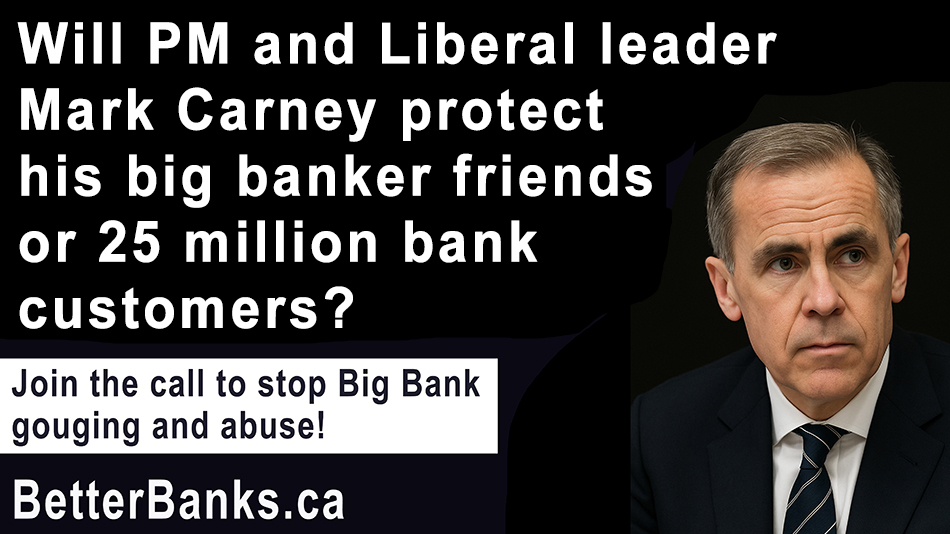
The Liberals and Conservatives, which have been the parties running the federal government since Canada became a country, have done very little to protect the 28 million customers of Canada’s Big Banks from gouging, discrimination and other abuses, and instead have been dedicated to protecting multi-millionaire bank executives from accountability for the harms their banks cause to financial consumers and individual investors, including by hampering bank watchdog agencies with weak enforcement powers.
The federal government’s Financial Consumer Agency of Canada (FCAC) has a very weak enforcement record since it was created in 2001.
It has made only 150 compliance rulings. Prior to 2019, the FCAC was not allowed to publicly identify a bank even if the bank violated the Bank Act and was fined for its violation The bank could only be identified if the FCAC prosecuted the bank, and since 2001 the FCAC has only prosecuted two banks (neither of them a Big 6 Bank).
The FCAC not only lacks resources by comparison to the similar watchdog agencies in Britain and the U.S., it is also clearly a lapdog compared to these two other agencies.
According to an article by Reuters in March 2017, and Democracy Watch’s research of fines imposed since then, the FCAC has issued fines totalling just $34 million since 2001 in the 150 rulings it has issued. Before 2001, there were essentially no consumer protections, and no penalties for harming consumers, in Canada’s Bank Act. From 2001 to 2007, the FCAC was only allowed to penalize a bank a maximum of $100,000 no matter how much a bank abused or harmed its customers, and no matter how many customers were harmed. The maximum fine was increased to $200,000 in 2007, and then to $500,000 in 2012, and then to maximum $10 million in April 2020.
Out of the total of $34 million in fines that the FCAC has imposed since 2001, almost all the fines have been imposed since August 2020 ($31 million has been imposed since September 2022, and another $2.7 million was imposed from August 2020 to December 2021). All of the above facts and figures show just how weak and ineffective the FCAC’s enforcement was before 2020.
However, the FCAC is still weak and ineffective. Given Canada’s Big Banks each make on average more than $10 billion in profits each year, the maximum fines before 2020 were ridiculously low and essentially meaningless, especially if the bank made more than a few hundred thousand dollars by violating the Bank Act. The current maximum $10 million fine is still too low as it is only a possible maximum fine (the FCAC has never fined a bank more than $6.5 millIon), and even if the maximum fine was ever imposed by the FCAC, it would only amount to about 0.1% of the average annual profits of any of Canada’s Big Banks.
In contrast, since 2013 when it was created until August 2026, Britain’s Financial Conduct Authority (FCA) imposed penalties totalling 4.9 billion pounds ($9.15 billion Can.), and since 2011 when it was created up to January 2025, the U.S. Consumer Financial Protection Bureau (CFPB) imposed penalties totalling more than $5 billion U.S. (more than $7 billion Can.) and an additional more than $21 billion U.S. (more than $29 billion Can.) in compensation and cancelled debts for financial consumers that have resulted from CFPB enforcement actions, for a total of more than $34 billion U.S. (more than $47 billion Can.) in financial penalties and costs for U.S. banks.
Key consumer protection rules need to be strengthened, and the FCAC must be required to do regular (at least twice annually) unannounced, mystery-shopper audits to find violations, required to publicly identify financial institutions who violate the rules, and required to impose high fines on violators. The FCAC didn’t do any unannounced audits of Canada’s Big Bank from 2005 up to the end of 2016, and then tipped off the banks in March 2017 about the audit they did through the rest of 2017 on abuses, and then allowed the banks to see the draft audit results and suggest changes that weakened the report. The FCAC finally did another unannounced mystery-shopper audit in fall 2019 which the FCAC initially buried but finally made public in May 2022. The audit found that 32% of bank account shoppers and 45% of credit card shoppers were misled and/or offered products and services that were not in their financial interest, especially Indigenous, visible minority and student shoppers. This result is not surprisingly given how weak and ineffective the FCAC’s enforcement had been since 2001. There is no evidence that the FCAC has done a mystery-shopper audit since 2019.
2. Ombudsman for Banking Services and Investments (OBSI) is also ineffective
The record of the Ombudsman for Banking Services and Investments (OBSI) since it was created in 1996 is not much better than the FCAC’s record, also in part because the federal government has failed to give it key enforcement powers. Initially, the majority of the members of the board of the Canadian Banking Ombudsman (CBO — it become OBSI in 2002) were from the banking industry so that made it biased in favour of the banks. Then after 2006, former Conservative Finance Minister Jim Flaherty allowed several of Canada’s Big Banks to leave OBSI and set up their own biased arbitrators to handle appeals of complaints.
Then Minister Flaherty and former Liberal Finance Minister Bill Morneau did nothing, and former Liberal Finance Minister Chrystia Freeland moved as slowly as possible, to require TD, Royal, Scotiabank and National Bank to stop using their own biased complaint judges and return to using the OBSI — which finally happened in November 2024.
However, since 1996, financial consumers and investors have been required to go through their bank’s or investment company’s internal complaint-handling process before they are allowed to file their complaint with OBSI, and banks and investment companies have delayed handling complaints or played other games to frustrate complainants in many cases. In addition, OBSI can only make recommendations about how a bank or investment company should resolve a complaint because the Liberals and Conservatives have failed to give OBSI the power to issue binding orders.
An FCAC investigation in 2018-2019 that was released in February 2020 found that Canada’s Big Banks have a horrible record of dealing with financial consumer and investor complaints, especially the banks that used their own complaint judges. Another review in 2024-2025 of small and medium-sized banks found that their complaint-handling systems also had several serious delays and barriers that frustrate customers who file complaints. There is no evidence that the FCAC has reviewed the Big Banks’ complaint-handling systems since 2019.
All banks and investment companies should be required to use OBSI, and financial consumers and investors must be allowed to complain directly to OBSI without having to go through a financial institution’s internal complaint system, and OBSI’s rulings on complaints by bank customers and investors must be made binding in every case.
B. Watchdogs need stronger powers and mandatory penalties
To ensure all violations of consumer rights and protections are effectively discouraged by high, mandatory penalties, and to ensure the watchdogs actually penalize violations, the OBSI and the FCAC and (in the case of prosecution) the courts must all be required to to impose a minimum fine of at least $1 million for each violation, and to impose a sliding scale of required higher fines that increase based on the seriousness of each violation, and must be required to impose a $50 million fine for each most serious, systemic violation. And they must be required to name and shame the violating bank each time they impose a fine.
The Financial Consumer Agency of Canada (FCAC) and the Ombudsman (OBSI) will continue to be ineffective until the federal government gives them key powers and requires them to use those powers to audit banks and other financial institutions regularly and to penalize every violation with a high fine (there should be minimum fines for various violations of at least $1 million, and the maximum fine should be $50 million) and public naming and shaming.
C. Citizen watchdog groups must be created to watch the watchdogs, and to represent and help consumers and investors
Finally, the federal government must establish broad-based, fully independent, national consumer and individual investor watchdog groups using a proven, low-cost and effective method. These groups are needed to empower financial consumers and investors by having their own watchdog groups that will: push the FCAC and OBSI to enforce protection and accountability laws effectively; represent them effectively in government policy-making and legislative processes; help them with expert advice for choosing the best products and services for their financial needs, and; help them complain effectively to their bank and/or investment company, and to the FCAC and OBSI, when they are gouged, discriminated against or abused, including by providing free legal services for individual and class-action lawsuits.
These groups can be created at little or no cost to governments or financial institutions using a method that has been proven in the U.S. to be very effective. The federal government can require banks, trust and insurance companies to promote in their mailings and emails to customers that they can join an independent, consumer-run Financial Consumer Organization (FCO) – as recommended in 1998 by the MacKay Task Force, and the House Finance and Senate Banking committees. Click here to see details about how to create the FCO and how the FCO would empower financial consumers.
In addition, the federal government can require the Big Banks and the largest publicly traded companies to promote in their mailings and emails to individual investors that they can join an independent, citizen-run Individual Investor Organization (IIO – as recommended by an Ontario legislative committee in 2006). Click here to see details about how to create the IIO and how the IIO would empower individual investors.
For more information, see Democracy Watch’s
Bank Accountability Campaign

(Français) Backgrounder – Weak Enforcement of Financial Consumer and Investor Protection in CanadaBackgrounder – Weak Enforcement of Financial Consumer and Investor Protection in Canada
Backgrounder – Canada’s Big Banks
(December 2025)
Controlling the market, and gouging out world-leading, record profits year after year for the past decade, while reducing service and treating many customers unfairly
According to Finance Canada, despite the lowering of barriers to competition 20 years ago under a World Trade Organization agreement, Canada’s Big 6 Banks:
- Bank of Montreal (BMO)
- Canadian Imperial Bank of Commerce (CIBC)
- National Bank
- Royal Bank of Canada (RBC)
- Bank of Nova Scotia (Scotiabank)
- Toronto Dominion Bank (TD)
control 93 per cent of all banking assets, and are more profitable than comparable banks in other countries, and than small banks in Canada, and Canada’s corporate sector overall. The big banks control of the market essentially allows them to gouge and abuse customers with excessive fees, high interest rates (especially on credit cards). As a result, government regulation is needed to stop them.
The federal government bailed out the banks with $114 billion in mortgage purchases during the financial industry fraud crisis in 2009. It hasn’t required the banks to do anything in return for that bailout, or for the protections from foreign competition that the government has given the banks since 1967.
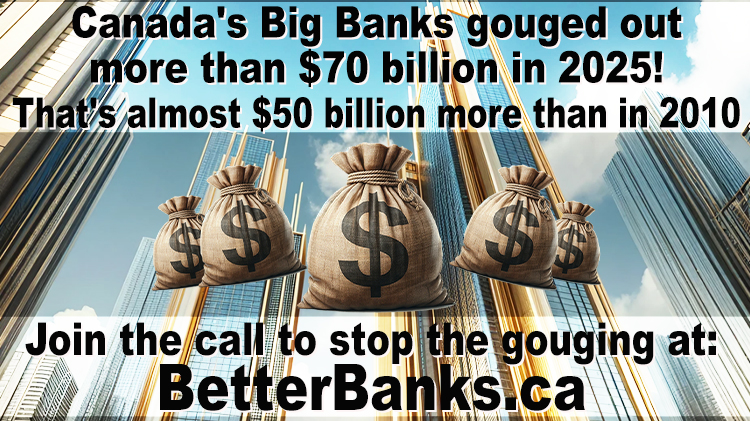
Canada’s Big 6 Banks reported, yet again, excessively high annual profits totalling $70 billion in 2025, almost $50 billion higher than their 2010 profits, all reaped through gouging their customers with excessively high credit card and other credit interest rates and mutual fund and other banking fees.
The banks gouged all Canadians who had loans back in 2015 by failing to lower their interest rates as much as the Bank of Canada had lowered its interest rate, and then the banks abused everyone with savings accounts by failing to increase their deposit account interest rates as much as the Bank of Canada when it began raising its interest rate in 2022.
Canada’s Big 6 Banks also paid their CEOs an average of $11 million each in 2023, and the average increased to $12.3 million in 2024 – 55% higher than in 2008).
Canada’s Big 6 Banks also handed out $27.3 billion in 2025 in bonuses to their employees.
The federal government also continues to refuse to make the Big Banks pay their fair share of taxes. Canada’s Big Banks pay a tax rate of only 16% — lower than banks in other G7 countries. The Big Banks also exploit tax loopholes more more than all other Canadian big businesses. England imposed a permanent annual excess profits tax on its banks in 2011, and Australia did the same in 2017.
For more information, see Democracy Watch’s
Bank Accountability Campaign
Backgrounder – Full List of Key Bank Accountability Changes
(September 2026)
The Liberals and Conservatives, which have been the parties running the federal government since Canada became a country, have done very little to protect the now 28 million customers of Canada’s Big Banks from gouging, discrimination and other abuses, and instead have been dedicated to protecting multi-millionaire bank executives from accountability for the harms their banks cause to financial consumers and individual investors. Many voters want strong financial consumer and investor protections, strong enforcement and high penalties for violations of these protections. Hopefully the Liberals and Conservatives, and all federal and provincial parties, will work together soon to enact the following key protection and bank accountability measures that other countries enacted long ago.
Democracy Watch’s letter-writing campaign and petition (which more than 120,000 Canadians have supported) call for the following key bank accountability changes needed to make Canada’s Big Banks give everyone a break on interest rates and fees, pay their fair share in taxes, and treat everyone fairly, now and after the coronavirus crisis is over:
- Require banks to cut credit card interest rates in half now (as they are at a gouging level now, and always have been excessively high), and allow people renewing their mortgages to re-renew without a penalty at a lower interest rate if interest rates decrease over the next few years, and require them also to lower all their interest rates at exactly the same time as the Bank of Canada lowers its interest rate over the next few years;
- Require banks, trust and insurance companies to promote in their mailings and emails to customers that they can join an independent, consumer-run Financial Consumer Organization (FCO – as recommended in 1998 by the MacKay Task Force, and the House Finance and Senate Banking committees) so consumers have a place to call for help if they are gouged or treated unfairly, and to get fully independent, expert advice (See details at: https://democracywatch.ca/question-and-answers-about-the-proposed-financial-consumer-organization/) and also require the banks and largest mutual fund companies to promote in their mailings and emails to customers that they can join an independent, consumer-run Individual Investor Organization (IIO – as recommended by an Ontario legislative committee in 2006) so they have have a place to call for help if they are ripped off or treated unfairly, and to get fully independent, expert advice (See details at: https://democracywatch.ca/question-and-answers-about-individual-investor-organization-iio/);
- Require banks to disclose the profit level of every part of their business (credit cards, mortgages, lines of credit, each other type of loan, bank machines, and investment and insurance divisions) after fully independent audits (overseen by the Auditor General);
- Require banks to keep all their interest rates and fees at a level that gives them no more than a reasonable profit (for example, many U.S. states cap credit card interest rates);
- Require banks to disclose detailed information about how many people and small businesses apply for credit cards and loans or all types, and loan interest rate cuts or other relief, and accounts, and how many are approved and rejected, by type of borrower and customer, and require corrective actions if a bank discriminates against any type of borrower or customer (as the U.S. has required banks to do for 40 years);
- Require the banks to re-open basic banking branches in every neighbourhood that offer low-interest rate, small-value lines of credit to everyone to stop predatory lending across Canada (including through partnering with Canada Post outlets for postal banking, as TD started to do in November 2022 but then paused and then cancelled);
- Require banks to give customers access to the money they deposit by cheque as soon as the cheque clears through the inter-banking clearance system;
- To stop fraud scams from taking huge amounts from customers’ bank accounts and credit cards, require banks to give customers the choice to set dollar-amount levels and geographic-location rules for notifications of suspicious account and credit card transactions, and require banks and telecommunication companies to prove that they took all due diligence steps to determine whether a transaction was fraudulent and to stop all fraudulent transactions, with the penalty of being required to reimburse the customer the total amount lost, and give customers the right to appeal the freezing of accounts and cards and to apply directly to the OBSI for compensation if the bank’s actions were unjustifiable and harmed the customer; (Similar to the measures enacted in Australia)
- Require banks and trust companies to disclose the profit/loss record for any branch proposed to be closed, to allow for a full public review of whether the closure is justified;
- Require banks and trust companies to prove that they have a fair, responsible and very good service, lending and investment record every year for the past 10 years as a mandatory condition for any financial institution bidding on federal government contracts;
- Strengthen key consumer protection rules, and require the Financial Consumer Agency of Canada (FCAC) to do unannounced, mystery-shopper audits to find violations, and to identify violators and fine them (the FCAC hasn’t done unannounced audits since 2005, tipped off the banks in March 2017 about the audit they did through the rest of 2017 on abuses, and then allowed the banks to see the draft audit results and suggest changes that weakened the report) and establish an independent, effective whistleblower protection system for the employees and everyone else who has any interactions with any financial institution;
- Require all banks to be covered by the Ombudsman for Banking Services and Investments, and allow financial consumers and investors to complain directly to OBSI without having to go through a financial institution’s internal complaint system, and make OBSI’s rulings binding;
- Require the FCAC to name every bank and financial institution that it finds has violated any rule and, given the big banks each make billions in profit annually, to fine violators a minimum of $1 million for each violation, and a sliding scale of higher fines must be required to be imposed up to the maximum $50 million penalty for the most serious, systemic violations;
- Close all the loopholes that allow Canada’s banks (and other big businesses) to evade paying taxes in Canada by pretending they make their money through companies they own in low-tax countries, and impose a special tax (as England and Australia have) on any Canadian business or bank that has excessively high profits like Canada’s Big Banks have had in the past several years, and;
- Require the Big Banks and other financial institutions to cut the pay of their CEO and other top executives to no more than 40 times their lowest paid employee (as in some European countries).
To see more details about why enforcement needs to be strengthened as proposed above in points #6-9, please click here.
Bank Accountability Campaign