Relatively low voter turnout and evenly split results mean Premier has no mandate on other 9 issues – especially given assumption should be that voters who did not vote would have voted “No” on each question
Too many questions, government-drafted questions, misleading questions, no court review of questions, government spending, flaws in donation and spending rules, lack of foreign interference and disinformation protections and lack of quorum all made the referendum processes undemocratic and unfair
FOR IMMEDIATE RELEASE:
Monday, October 26, 2026
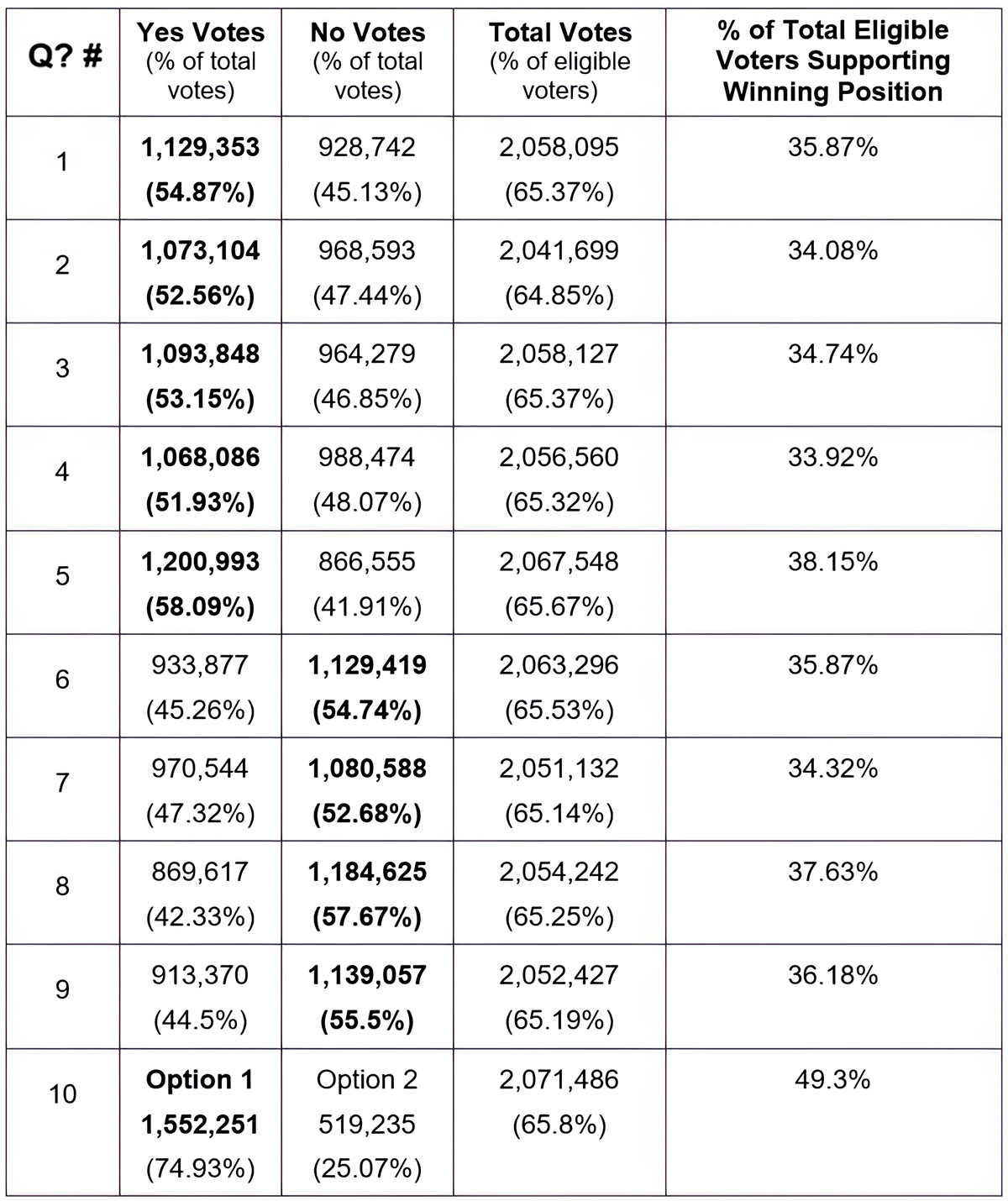
OTTAWA – Democracy Watch’s conclusion is that the delayed, finally completed (but still unofficial) results of Alberta’s very flawed referendums (See details about the flaws further below) show clearly that Premier Danielle Smith and her UCP government have no mandate to do anything except abandon any moves toward the separation of Alberta from Canada (give just under 75% of voters voted Option 1 to not hold a referendum on separation). See table further below for a detailed breakdown of the votes question by question.
It is clear that Premier Smith has no mandate to make any moves in any of the issue areas addressed by the other 9 referendum questions given that:
- The No side won on questions 6-9;
- On questions 1-5, there was relatively low voter turnout averaging 65.3% and roughly even split results so, at most, only 38% of the just under 3.15 million total eligible voters supported any of the proposed changes in those 5 questions, and;
- The assumption should be that most of the voters who did not vote would have voted “No” on each question, as not voting indicates fairly clearly that they were not interested in having the change made that was proposed in each question.
Why should the assumption be that most of the voters who did not vote would have voted No on all 9 questions (and for Option 1 in question #10)?
In an election under a first-past-the-post system like Canada uses, low voter turnout does not indicate such a clear lack of interest in who wins because voters in any riding that is consistently “safe” for one party (and there are many such ridings) have a rational reason for not voting (whether they are voting for or against the candidate of the party that always wins).
In contrast, in a referendum if a voter wants the “Yes” side to win they have no rational reason for not voting. Voters who have no interest in having the change made that is proposed in a referendum question express their lack of support for the change (i.e. vote No) fairly clearly by not voting on the question.
“The results show clearly that Premier Smith and her UCP government have no mandate from the ten referendums to do anything except abandon support for Alberta separation,” said Duff Conacher, Co-founder of Democracy Watch.
The results in the following table show clearly that Premier Smith has no mandate to do anything in any issue area except abandon separation (winning side is in bold):
Democracy Watch’s position is that referendums can be a good complement to Canada’s parliamentary system, and that the barriers to voters initiating a referendum should not be excessively high. However, as with elections, the referendum process must be structured in very specific ways to be democratic and fair, and the Alberta government has failed in many ways to ensure a democratic and fair process.
Undemocratic and unfair decision-making processes in the legislature or in referendums lead to undemocratic results. Click here to see details about the 12 key ways that the Government of Alberta’s process for the 10 referendums was undemocratic and unfair, and also facilitated foreign interference. In 1991, Conacher had published one of the first academic articles analyzing and proposing almost 90 key measures for democratic, fair referendum processes.
“Allowing voters to have their say through referendums doesn’t automatically make the process democratic and fair, and Alberta’s process was undemocratic and unfair in many key ways,” said Conacher. “Too many questions, government-drafted questions, misleading and vague questions, no court review of the questions, government spending, undemocratic flaws in donation and spending rules, lack of foreign interference and disinformation protections and the lack of a quorum all combined to make Alberta’s referendum process undemocratic and unfair.”
“Undemocratic and unfair referendums should not be used to manipulate voters and further a government’s agenda, in the same way that using undemocratic and unfair processes in the legislature like omnibus bills and debate closure, and prorogations and snap election calls, should not be used to manipulate members of the legislature and voters in order to further a ruling party’s agenda,” said Conacher. “The laws that set out the rules for referendum processes at the federal level, and in several provinces, have the same loopholes and flaws as Alberta’s laws, and referendums should not be held anywhere in Canada until these loopholes are closed and flaws corrected.”
– 30 –
FOR MORE INFORMATION, CONTACT:
Duff Conacher, Co-founder of Democracy Watch
Tel: (613) 241-5179
Cell: 416-546-3443
Email: [email protected]
Democracy Watch’s Voting Systems Campaign