Liberals now proposing some measures they voted against when opposition parties proposed amending last year’s budget Bill C-15
Fraud costing Canadian bank customers $700 million + each year – UK and Australia have enacted protections while Liberals delay action
Other key measures also needed (which U.S., Australia and/or UK have enacted), to stop bank gouging, discrimination and abuse and ensure banks pay their fair share in taxes – Liberals have done little since 2015
FOR IMMEDIATE RELEASE:
November 25, 2026
OTTAWA – Today, Democracy Watch called on the Carney Liberal government to strengthen the measures proposed in the Budget 2026 document, and a related policy statement, so that they will actually protect consumers from bank account fraud. The Liberals have been delaying effective action to solve the rampant, cross-Canada fraud problem for years.
The Carney Liberal Cabinet is now proposing essentially the same measure (with some possible loopholes) that Liberal MPs (and Conservative MPs) voted against last February when Bloc Québecois MP Jean-Denis Garon proposed an amendment to Bank Act changes contained in last year’s budget Bill C-15. The promised measure is that consumers will not be responsible for the loss of their money due to fraud or a scam as long as the theft was an “unauthorized access” to their account and there was no “gross negligence” on the part of the customer.
But, even if the Liberals actually enact that measure (which may not even happen for years, as the Liberals have delayed past consumer protection measures for years), it will not do enough to protect consumers. The banks often blame their customers for the fraud and refuse to compensate them for lost money even when the fraudsters do account transactions that the customer has never done in decades or when bank staff allow or facilitate the fraud or scam. As well, the measure has loopholes in it as the banks will likely always argue that the customer is to blame because they gave access to their account or were grossly negligent in some way.
In addition, the banks will also likely drag out customer complaints for years, in the same way that customers of Canada’s big airlines waste years and money trying to get compensation from airlines for delayed or cancelled flights because of the weak, ineffective measures the Liberals enacted.
The Liberals and Conservatives also voted against a separate amendment to last year’s budget Bill C-15 proposed by NDP MP Don Blaikie. The amendment would have actually protected consumers because it required (as is required in the UK) that the bank return at least some of the customer’s money right away. Then the bank would have to pay back the rest of the customer’s money unless it could prove to the Ombudsman for Banking Services and Investments (OBSI) that the bank: has adequate safeguards to prevent fraudulent account transactions; has fully trained their staff in those safeguards; did their due diligence to prevent the fraud from happening, and; that the customer was grossly negligent and, as a result, partially or fully responsible for the loss of their money.
This system reverses the onus and requires action by the bank, not the customer, which is the way the system should work given: the customer has little or no money (because it has been stolen by the fraudsters); banks have extensive resources and lawyers to protect themselves during a complaint process (the costs of which are all covered by their customers who pay excessive fees and interest rates), and; banks are almost always at least partially responsible for allowing fraudsters to drain their customers’ bank accounts.
Click here to see a summary of the UK rules and system. Australia has enacted rules for banks, telecom and Internet companies, and is considering a $3,000 automatic reimbursement to fraud victims. Click here to see a summary of Australia’s rules and system.
In addition to promising to change the Bank Act so that consumers would not be liable for loss of their money from “unauthorised access” to their account unless the consumer is “grossly negligent” (both of which could be loopholes as banks could always take argue the customer , the Liberals’ proposed measures also promise changes to federal laws:
- To give the CRTC “the authority to introduce fraud prevention obligations for telecommunications service providers” and to monitor telecom fraud.
- To amend “Canada’s Anti-Spam Legislation (CASL), including providing authority for the CRTC to proactively disclose information to law enforcement.”
- To designate an entity to recommend resolutions to fraud complaints that banks, telecom and Internet companies do not resolve themselves (likely it will be OBSI).
See the measures in the Budget 2026 document (Chapter 5.3 under the heading “Delivering Canada’s National Anti-Fraud Strategy”), and in the related “Policy Statement: Canada’s National Anti-Fraud Strategy” (subsections 3.1-3.3).
But these promised measures by the Liberals will only give the CRTC powers it may never use, and the external complaints entity won’t have the power to order a bank, telecom or Internet company to compensate a customer or penalize the bank or company for allowing the fraud to occur (Australia has established a $50 million penalty for each violation that fails to protect consumers).
“After failing to take any effective action to stop bank account fraud and online scams for the past decade, the federal Liberals are finally promising to take some actions and change federal laws that apply to banks and telecom and tech companies in some ways, but not all of the key ways needed to protect consumers from scams and fraudsters,” said Duff Conacher, Co-founder of Democracy Watch.
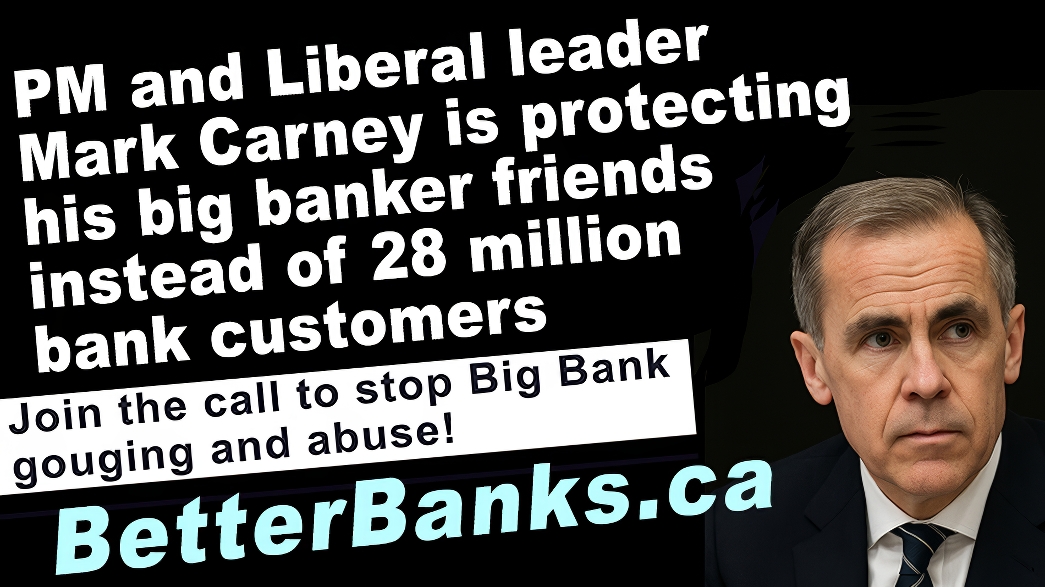
“PM Mark Carney and his Liberal Cabinet are still protecting his big banker friends from accountability as they continue to fail to require banks to give financial consumers all or part of their money back right away when they are defrauded, which is how the system should work given the bank is almost always at least partly to blame for money being stolen from an account,” said Conacher. “Unless this requirement is imposed on banks, defrauded bank customers will have to wait years to get their money back from their bank, just like airline customers have to wait years under the Liberals’ deeply flawed air passenger complaint system for airlines to pay them back after their flight is cancelled or delayed for no good reason.”
“If the federal government doesn’t make the proposed fraud complaint watchdog fully independent from banks, telecom and tech companies, and doesn’t empower the watchdog to make binding rulings on fraud complaints and to impose high fines on banks and companies that fail to protect consumers, the watchdog will end up being as much of a toothless lapdog as the current ombudsman for banking services and investments has been for the past 25 years,” said Conacher. (See Backgrounder on Weak Enforcement of Consumer and Investor Protection in Canada).
Democracy Watch also called on the Carney Liberals to stop protecting his Big Bank executive friends in other ways, and to work with all federal parties to make other key changes that the U.S., Australia and/or the UK have already made to protect bank customers from gouging, discrimination and other abuses.
More than 120,000 voters have signed on to Democracy Watch’s letter-writing campaign or Change.org petition calling for these key changes, some of which the U.S. enacted decades ago, and some of which Australia and England have enacted in the past several years (See Full List of Key Bank Accountability Changes).
“The Liberals continue to protect the big bank’s excessive gouging profits and their executives’ excessive multi-million salaries instead of making the changes needed to stop banks from gouging billions from their 28 million customers and to protect bank customers from discrimination and other abuses,” said Conacher.
“Every dollar of excessive profit for the banks, and every person and business the banks unjustifiably refuse to loan to, costs the Canadian economy because it means that the banks are overcharging for their essential services and loans, and choking off job creation and spending,” said Conacher.
Canada’s Big 6 banks recorded huge, gouging profits in 2025 of $70 billion, almost $50 billion more than in 2010, and 5 of the Big 6 were in the top 50 most profitable banks in 2024, and pay billions in bonuses to their employees and $12 million on average to their CEOs. See details in Canada’s Big Banks Backgrounder.
– 30 –
FOR MORE INFORMATION, CONTACT:
Duff Conacher, Co-founder of Democracy Watch
Tel: (613) 241-5179
Cell: 416-546-3443
Email: [email protected]
Democracy Watch’s Bank Accountability Campaign