

Advocating for stronger and more democratic political donation, loan, finance and spending laws
Money to the Ref? We don’t allow that in hockey or other sports – but in politics it’s legal!
Politicians are supposed to be the referees who decide what is in the public interest – so why do we allow wealthy lobbyists and voters buy them off with thousands of dollars in donations and loans each year, and with secret fundraising favours?
And why do we allow big businesses, lobby groups and wealthy voters to spend secret, unlimited amounts of money between elections on advertising and other activities aimed at unduly influencing politicians’ decisions and actions. And why do we allow big businesses (which are controlled by just a few wealthy executives) and wealthy voters to spend as much during elections as citizen groups that are supported by tens of thousands of voters?
Please send your letter now using the form on this page, and please help spread the word by Liking and Tweeting this page.
(See below for more details about the loopholes and flaws in Canada’s political finance laws)
Key Links
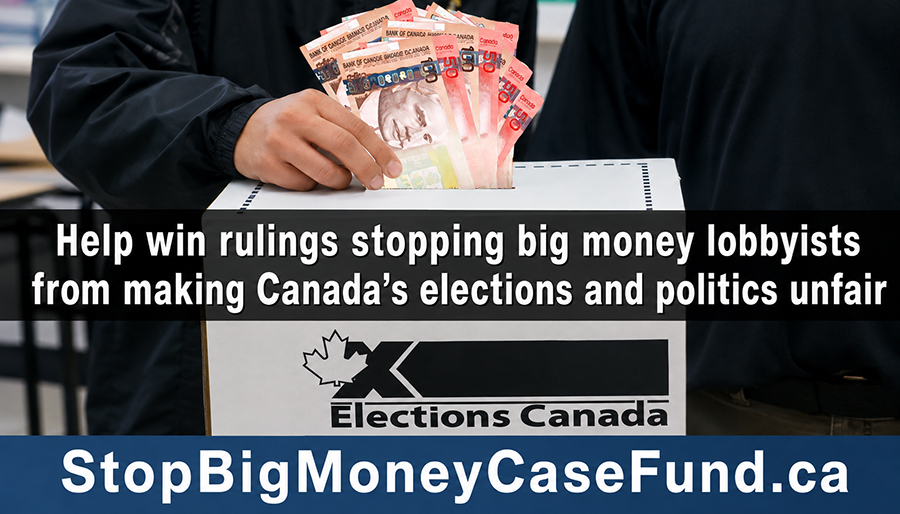
- Stop Big Money Court Case Fund
- Infographic webpage on Key Facts about Big Money and How to Stop It
- List of sham political donation systems across Canada
- Summary of Loopholes in Canada’s “Third Party” Lobby Group Spending Rules
- Summary of Third Party Advertising Spending Limits Court Case (archive website)
- Please download and post on social media or print and post everywhere the I’m Voting for Good Government sign
- Call on the politicians that represent you to Make the Democratic Good Government Pledge
Campaign News
Read all campaign news
Money in Politics Campaign 1993-2011 archive (archive website)
The Opportunity
Surveys show that a large majority of Canadians believe governments are driven by wealthy interest groups, especially big businesses, and that governments regularly act unethically to help their big business executive friends and are not doing enough to stop corruption. Surveys also show that a large majority of Canadians support placing strict limits on the influence of wealthy interests in politics.
Many scandals in Canadian politics have made many people realize how loophole-filled and weak the restriction of money in politics is in Canada.
Italian police have said that Ontario has a mafia corruption problem in the construction industry even worse than in Quebec.
As a result, the pressure is increasing on all politicians, and all governments, to clean up their political finance systems.
Background
From 1998 to 2016, Democracy Watch organized and coordinated a national coalition of 50 citizen groups, and activated voters across Canada, to win key money in politics reforms – more detailed disclosure of political donations, a ban on political donations by businesses, unions and other organization, and limits on individual donations and on spending by third-party lobby groups, at the federal level and in six provinces and two territories (Quebec enacted a ban and limits in the late 1970s, and Manitoba in 2001, and now only Saskatchewan, Newfoundland and Labrador allow unlimited donations from businesses, unions, organizations and individuals and unlimited spending by lobby groups).
However, the annual donation limits that have been set at the federal level and in most provinces and territories much higher than what most voters can afford to donate as they range from $1,200 up to more than $5,000. Only Quebec has a democratic donation limit of $100 annually. Democracy Watch’s research shows that most donors only donate $75 a year – click here to see details.
The high donation limits also favour wealthy parties and candidates supported by wealthy donors, and the high limits also facilitate funnelling of donations (click here to see details). Combined with the facts that individuals (including lobbyists) are allowed to secretly fundraise for political parties and election candidates, and (other than in Ontario) donations are only disclosed once a year, and after elections, the system essentially legalizes bribery – click here to see details.
In addition, banks and other financial institutions are allowed to loan an unlimited amount of money to political parties and election candidates, which allows them to use loans as a means of influence.
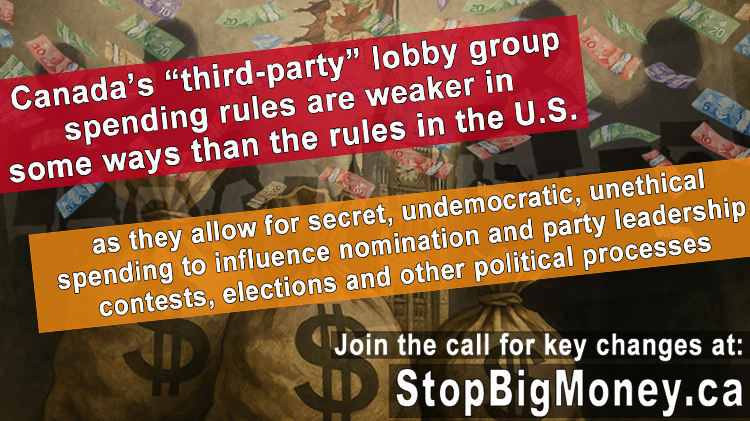
The third-party lobby group (and individual) spending limits that have been set at the federal level and in most provinces and territories all allow for secret, undemocratic, unethical and undue influence by wealthy interests – click here for details. There are no registration or disclosure requirements, or spending limits, for third parties trying to influence nomination contests or political party leadership contests. Third parties are also allowed to spend their “own funds” during election campaigns, which hides the donors who gave them those funds, and are not required to disclose any of their donors until after voting day.
The same spending limit applies for every type of third party, whether the third party is an individual, a citizen group supported by tens of thousands of voters, or an individual voter or private corporation or a publicly traded business that is directed only by a few voters, which gives wealthy voters and businesses undue influence.
Third-party registration requirements and spending limits also only apply during short (4 to 6 week) federal, provincial and territorial election campaign periods or just before campaigns begin, and don’t apply to all influence activities. The requirements and limits don’t apply between elections when lobby groups try to influence policy-making processes. The requirements and limits also usually don’t apply at all to municipal elections or policy-making processes.
Democracy Watch continues to lead the movement across Canada for key reforms to close these loopholes and correct these flaws to stop the unethical, undemocratic influence of big money in Canadian politics.
Please send your letter now calling for key changes to Stop Big Money in Politics using the form on this page, and please help spread the word by Liking and Tweeting this page.