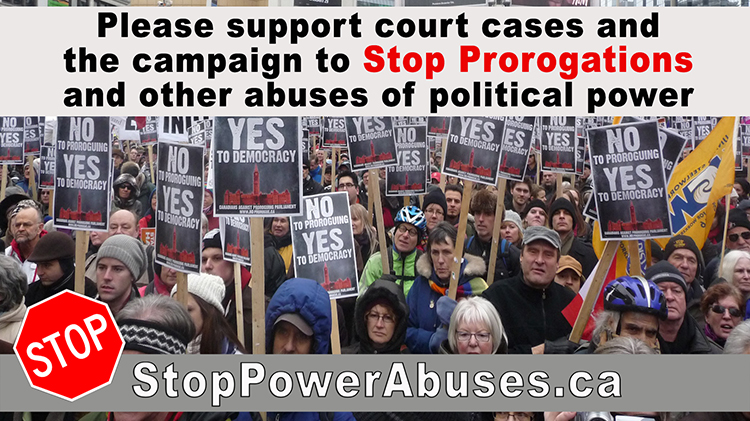
Federal Court of Appeal should hear the appeal, and should issue ruling that not only rejects Trudeau’s unjustifiable prorogation, but also restricts PM’s power to prorogue Parliament in future
Prorogation was in Liberal’s self-interest, opposition parties intended to vote non-confidence in the government, other options were available
FOR IMMEDIATE RELEASE:
Wednesday, April 22, 2026
OTTAWA – Today, Democracy Watch is an intervener at the Federal Court of Appeal (FCA) in the first hearing of the first step of the appeal of the Federal Court’s ruling in the case challenging the January 6, 2025 request by Prime Minister Trudeau that the Governor General prorogue (shut down) Parliament until March 24, 2025.
Today’s hearing is focused solely on the issue of whether or not the FCA should hear the appeal given the prorogation ended long ago. Both the appellants and the Attorney General of Canada want the appeal to go ahead, as does Democracy Watch, so that the FCA will issue a ruling on the important legal issues re:
1. Whether the Prime Minister can prorogue Parliament anytime the PM wants, or are their constitutional restrictions on prorogations?
2. Whether the courts should hear and rule on challenges to prorogations?
The hearing of this first step of the appeal is this morning, April 22nd from 9:30 am to about 11:30 am at 180 Queen St. W., 7th floor in Toronto or click here to register to watch it online (under Hearing Lists, File #A-131-25, David Joseph MacKinnon et al v. Canada (Attorney General) et al). Democracy Watch is represented at the hearing by Justyna Zukowski, and also Wade Poziomka, Nick Papageorge, of Ross & McBride LLP.
The prorogation was clearly in the Liberal Party’s self-interest as it gave the party time to hold its leadership contest to replace Trudeau, and happened at a time when the opposition parties were clearly intending to vote non-confidence in the government soon after Parliament’s usual winter break was scheduled to end on January 27, 2025. (Click here to see DWatch’s legal arguments).
Democracy Watch is calling on the court to reject Trudeau’s unjustifiable prorogation and issue a ruling like the UK Supreme Court’s unanimous 2019 ruling that it was illegal for then-Prime Minister Boris Johnson to prorogue Parliament for no justifiable reason when a majority of MPs wanted Parliament to stay open and operating.
Democracy Watch is also calling on the court to look forward and issue a ruling that will prevent the current bad situation from happening again. The court should establish restrictions on the Prime Minister’s power to prorogue Parliament in the future, restrictions that comply with binding Supreme Court of Canada rulings that mandate courts to balance the power of the PM with Canada’s key constitutional principles that require the government (the PM and Cabinet) to have the support of a majority of MPs (known as the principles of responsible government, the sovereignty of Parliament, and democracy).
The three practical restrictions that Democracy Watch is calling on the court to establish on the PM’s power to prorogue, restrictions that will work in every future situation, especially during minority governments, are as follows:
1. Has notice of a motion of non-confidence in the government been given in Parliament, or has a vote on a matter of confidence (e.g. a supply measure) been scheduled in Parliament? If yes, then the Prime Minister is prohibited from proroguing until the motion or vote is decided.
2. If the answer to question #1 is no, have the leaders of opposition parties who represent a majority of MPs in the House of Commons clearly and publicly indicated that their parties’ MPs intend to vote non-confidence in the government? If yes, then the Prime Minister is prohibited from proroguing outside of, and longer than, a scheduled adjournment period of Parliament.
3. If the answer to question #2 is no, have a majority of MPs voted in favour of a prorogation at a time that is outside of and/or longer than a scheduled adjournment period of Parliament? If yes, then the Prime Minister is permitted prorogue Parliament for that time period.
“While a non-confidence motion was not being debated when Trudeau’s prorogation was requested, and while it is fair to allow a political party to change leaders before an election occurs, the Prime Minister dictating that Parliament must shut down for almost three months to avoid a non-confidence vote in his government that would trigger an election, without consulting any opposition leaders or even Liberal MPs, is fundamentally undemocratic and unjustifiable,” said Duff Conacher, Co-founder of Democracy Watch. “The Prime Minister had other options and, from all evidence, could have reached an agreement sometime in 2024 with one or more opposition parties to have the Liberals hold a party leadership contest while Parliament continued operating.”
“Hopefully the courts will take this opportunity to restrict this kind of abuse of power from happening in the future by issuing a ruling that makes it clear what is a legal, justifiable prorogation and what amounts to an illegal prorogation,” said Conacher. “All federal parties should also work together to set out clear rules that restrict prorogations, snap elections, and other powers of the Prime Minister, like the rules enacted years ago by all parties in Britain, Australia and New Zealand parties.”
– 30 –
FOR MORE INFORMATION, CONTACT:
Duff Conacher, Co-founder of Democracy Watch
Tel: (613) 241-5179
Cell: 416-546-3443
Email: [email protected]
Democracy Watch’s Stop Prorogations and other Power Abuses Fund